Key takeaways
- Carriers bill the greater of actual weight and dimensional weight, so empty space is charged as if it were product.
- UPS publishes a DIM divisor of 139 for Daily Rates and 166 for Retail Rates; FedEx uses 139 for US parcel services. Confirm against your own contract.
- On a 12 x 10 x 8 in carton, growing to 14 x 12 x 10 in adds about 75% to the billable volume — often a full rate tier.
- Void fill is a per-parcel cost that scales with the empty space, not with the product.
- A snug carton also reduces damage, because the product cannot build up momentum inside the box.
- One-size-fits-all only wins when the SKU range is narrow; past roughly 2 in of size spread, a second carton size pays for itself.
You pay for space twice
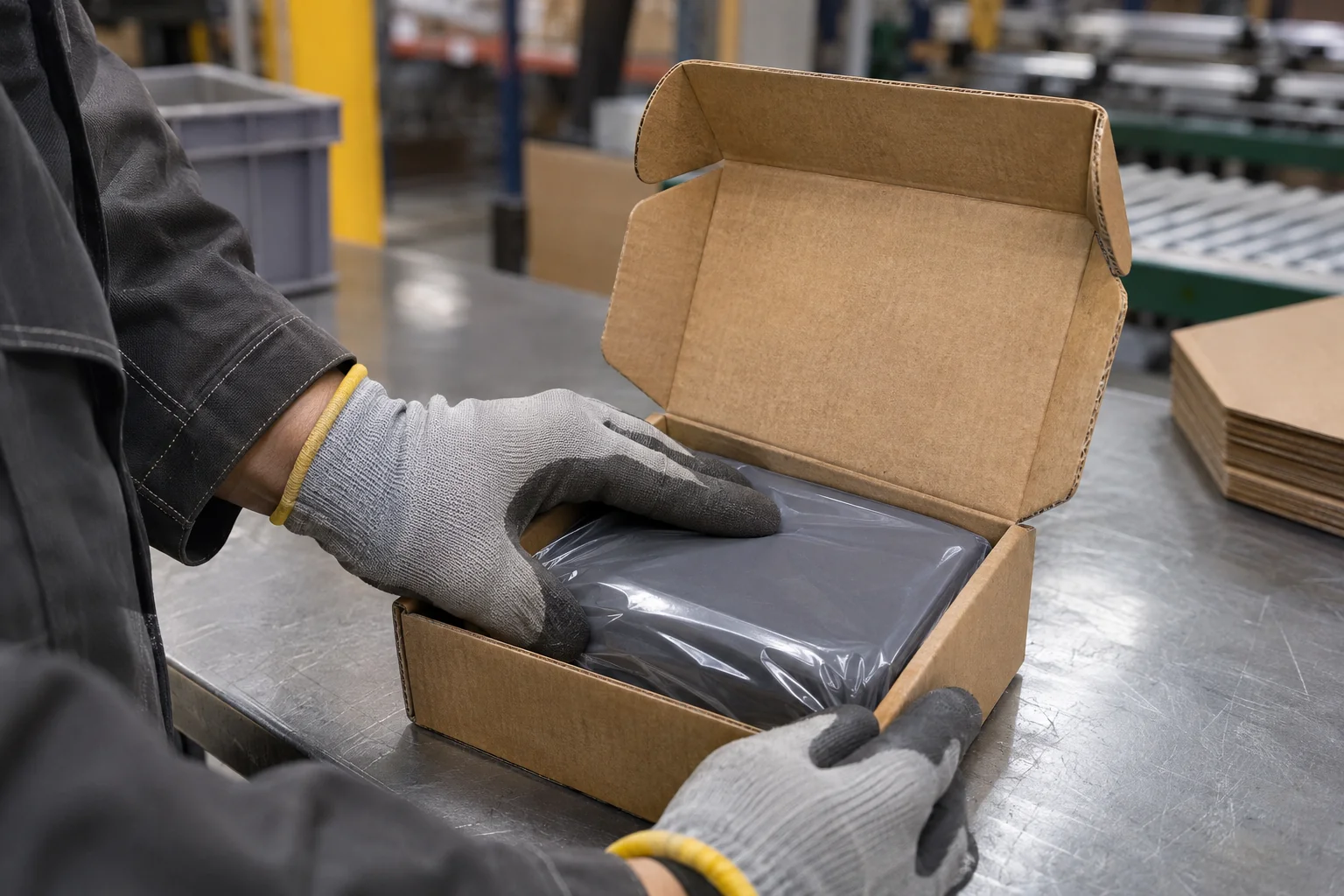
Most packaging cost discussions start with the price per carton. That number is the smaller half of the story. The carton you specify also sets how much the carrier charges to move it and how much filler you have to buy to make it safe.
The two effects pull in the same direction. When a carton grows, board area grows roughly with the square of the dimensions, billable volume grows with the cube, and the void fill needed to keep the product still grows with the empty space. None of those costs go away when the product gets smaller — they only go away when the carton does.
This is why two suppliers can quote the same product, the same board grade and the same print, and one landed cost per unit is visibly higher. The difference is often not the carton price at all. It is the cubic inches.
How dimensional weight works
Parcel carriers price on billable weight, which is the greater of the scale weight and the dimensional (DIM) weight. DIM weight converts volume into an equivalent weight:
DIM weight (lb) = L × W × H (in) ÷ DIM divisor
The divisor is the number of cubic inches the carrier treats as one billable pound. UPS publishes 139 for Daily Rates and 166 for Retail Rates; FedEx uses 139 for its US parcel services. These are published figures, but they are also commercial terms, so check the current service guide or your own negotiated agreement before you build a cost model on them.
| Carrier / rate type | DIM divisor | Practical effect |
|---|---|---|
| UPS Daily Rates | 139 | Standard benchmark for negotiated accounts |
| UPS Retail Rates | 166 | Lower DIM weight per cubic inch, higher base rate |
| FedEx US parcel services | 139 | Applies across the US parcel portfolio |
| Air freight volumetric (industry convention) | 166 | 1 kg per 6,000 cm³; different billing model |
Figures as published by UPS and FedEx and current at the time of writing. Divisors and rate structures change; verify before quoting a customer.
Two practical details decide whether you actually pay DIM weight. The first is rounding: carriers measure to the nearest whole inch or half inch and round fractional billable pounds up, so a carton sitting just over a tier boundary is the expensive place to be. The second is density: the crossover point at which DIM weight overtakes actual weight depends on the product. For foam, bedding or flat-pack furniture, DIM weight almost always wins. For dense industrial parts it rarely applies at all. If your denser product is shipping at DIM weight, the carton is the first place to look.
Worked example: 2 in per side
Take a consumer product that genuinely needs a 12 x 10 x 8 in internal carton. C-flute single wall adds about 4 mm per wall, so external dimensions are roughly 12.3 x 10.3 x 8.3 in. Now compare it with a stock carton a buyer might pick to "leave a bit of room": 14 x 12 x 10 in.
| Carton (outer) | Cubic inches | DIM weight @139 | DIM weight @166 | Void fill needed |
|---|---|---|---|---|
| 12.3 × 10.3 × 8.3 in | 1,051 | 7.6 lb | 6.3 lb | Minimal |
| 14 × 12 × 10 in | 1,680 | 12.1 lb | 10.1 lb | ~2 in per side |
| Rounded billable (139) | — | 8 lb vs 13 lb | 7 lb vs 11 lb | — |
The product did not change. The board grade did not change. The billable weight rose by roughly 60% at a 139 divisor, because the carton adds 60% more cubic volume before rounding, and then rounding pushes it across a tier.
Now turn that into an annual number. At 20,000 parcels a year, an extra five billable pounds per parcel at a mid-tier ground rate is a five-figure annual cost. Against that, the carton price difference between the two sizes is usually a few cents.
The size you specify on the drawing decides this
Dimensional weight is set by the external dimensions the factory produces, not by the product. If you send product dimensions and a target parcel cost, we will return the smallest carton that still passes your handling and protection requirements. Send product dimensions for a sizing check.
Void fill is not free
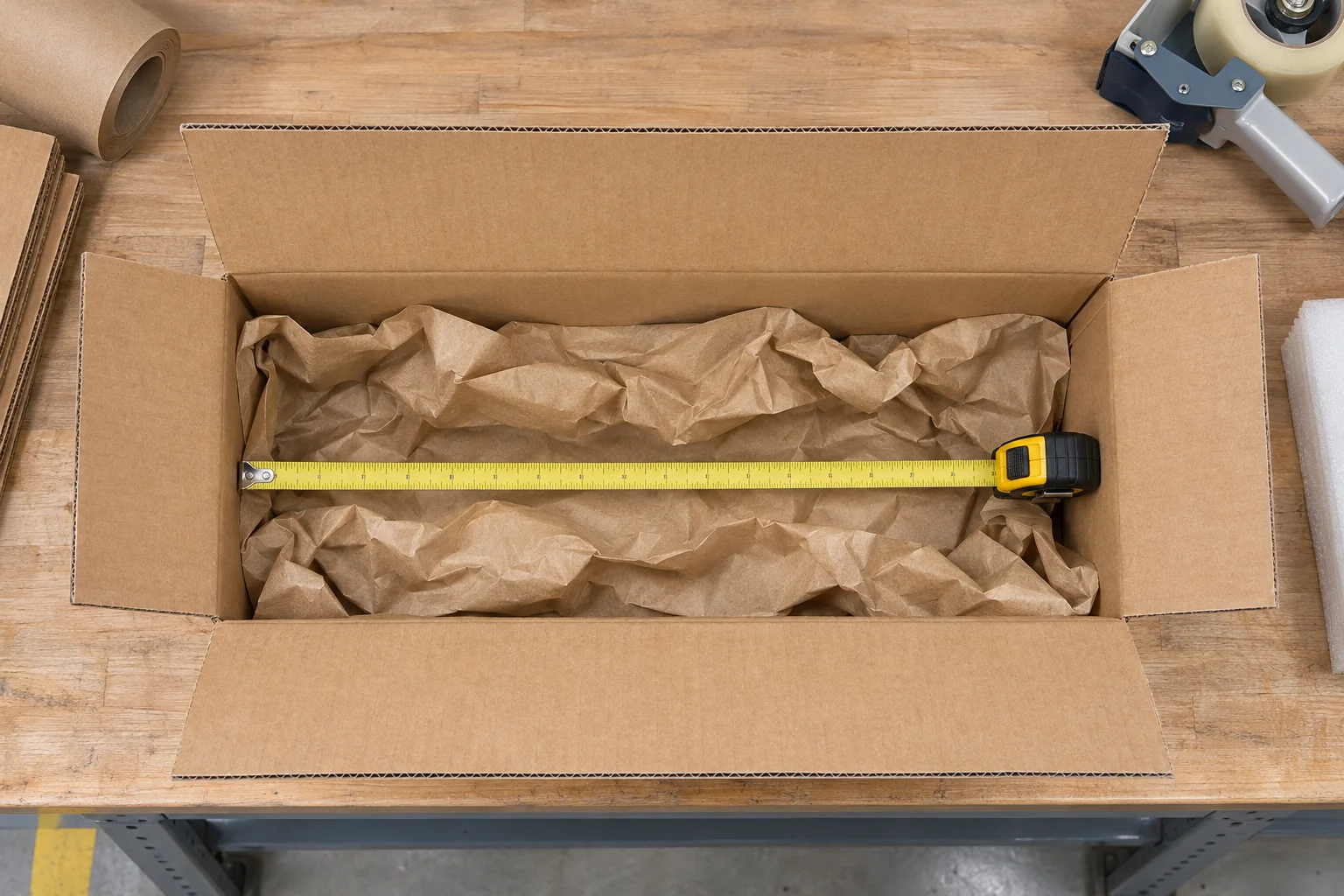
Every inch of empty space has to be filled with something, or the product will move. Void fill carries its own cost per parcel, its own labour time, its own storage footprint, and — depending on the material — its own recyclability story that your customers may ask about.
Air pillows, kraft paper, moulded pulp inserts, corrugated partitions and foam all behave differently, and none of them are free at the packing bench. A carton with 2 in of slack per side needs a materially different fill strategy from one with 1/8 in of clearance and a snug fit.
| Fill method | Works best when slack is | Cost behaviour | Recyclability notes |
|---|---|---|---|
| None — snug fit with clearance | ≤ ¼ in per side | Lowest cost per parcel | Paper-based, kerbside friendly |
| Kraft paper, crumpled | ¼ – 1 in per side | Scales with empty volume | Paper stream, widely accepted |
| Air pillows | 1 – 2 in per side | Low material mass, high labour | Film stream; check local acceptance |
| Corrugated inserts / partitions | Any, if designed in | Fixed tooling, low per-unit | Same stream as the carton |
| Moulded pulp or foam | Any, if tooled | Tooling cost, protective | Pulp recyclable; foam usually not |
The pattern is consistent: as slack grows, you move down the table towards more material, more labour and more complex recycling messaging. A carton matched to the product lets you stay at the top of it.
The same picture appears in reverse in a mailer box programme. Mailers are die-cut to the product, so the fit is built into the tooling rather than bought per parcel — which is why high-volume e-commerce lines with a stable product range often move from RSC plus fill to a die-cut mailer once volumes justify the die.
Damage goes up, not down
There is an intuition that a bigger box protects better. In practice the opposite is often true. Void fill compresses under vibration and settles; once it settles the product has room to accelerate, and it arrives at the customer having taken impacts that a snug carton would have absorbed through the board itself.
Parcel test protocols exist to catch exactly this. ISTA 3A simulates the parcel delivery environment — handling drops, random vibration and atmospheric conditioning — for individual packaged products up to 150 lb (70 kg), and its random vibration profile is designed to reproduce the settling and abrasion that a loose product experiences in transit. A carton that passes a drop test on day one but settles by the sorting hub is the failure mode the vibration step is looking for.
Amazon's FBA inbound requirements point the same way for a different reason. Cartons must be rigid and six-sided, with limits of 50 lb per box (40 lb for jewellery and watches) and 36 × 25 × 25 in, and the guidance asks for at least 2 in of cushioning between product and carton wall and a shake test before sealing — the contents should not move. That is a compliance floor, not an efficiency target: a carton that only meets the 2 in rule by accident is almost certainly paying DIM weight it does not need to.
Damage cost is rarely just the product. It is the replacement, the return freight, the customer service time and, on marketplace channels, the account health metric. A carton that is 15% oversized to "be safe" is a bet that rarely pays.
How to right-size a carton

Right-sizing is arithmetic plus one test. Work through it in this order.
- Measure the product envelope, not the product. Include handles, cords, manuals, poly bag thickness and anything that ships with it. Measure the packed orientation, the way it will actually sit in the box.
- Add clearance. 3 to 6 mm (⅛ to ¼ in) per side for a rigid hand-packed product; 6 to 10 mm where the product is bagged, wrapped or sits in an insert. Add more only where the packing line or the product actually needs it.
- Add the board caliper. Outer = internal + 2 × caliper per axis. C-flute single wall is about 4 mm, BC double wall about 7 mm, triple wall about 12 mm. This step is where pallet patterns get broken — see how to measure a box for the full conversion.
- Convert to billable weight. Multiply external L × W × H, divide by your DIM divisor, and compare with the actual weight. If DIM weight wins by a wide margin, the carton is oversized for the product.
- Check the pallet and container maths. A carton that saves 10% of parcel volume but drops your pallet from 48 to 40 cases has made things worse for freight. Run both numbers before you commit.
- Test one layer. Ask for a small run in the proposed size, pack it on the real line, and drop test a filled carton. Confirm the product cannot move and that the packers can close it at line speed.
Where the answer is "the carton must be bigger than the product", the usual reasons are legitimate: the product needs cushioning volume for a fragile component, the carton must hit a standard pallet footprint, or the retail channel requires a minimum display size. Those are decisions to make deliberately and price in, not to arrive at by choosing the nearest stock size.
If your range includes flat or semi-flat items, a die-cut mailer or a die-cut printed carton usually beats an RSC plus filler on both dimensions and presentation. The corrugated box price guide covers how board area, flutes and print each move the per-unit price once the size is fixed.
When one carton size still wins
Right-sizing is not the same as buying a dozen sizes. Every carton SKU you add costs purchasing time, warehouse space, a minimum order quantity and a chance of a packer reaching for the wrong box. Below a certain spread, one size is genuinely cheaper overall.
| Your situation | Better strategy | Why |
|---|---|---|
| Product range varies by less than ~2 in per side | One carton size | DIM penalty is small; SKU complexity is not |
| Range varies 2–6 in per side, mid volume | Two or three sizes with tiered pricing | Volume saving outweighs extra SKU cost |
| Range varies widely, high volume | Die-cut to product, one die per SKU | Fit designed in, fill eliminated |
| Product must hit a fixed pallet footprint | Size to the pallet, accept DIM | Freight saving dominates parcel cost |
| Fragile, high-value product | Size to the cushion, not the void | Protection requirement sets the volume |
| Low volume, many SKUs, first year | Two stock sizes plus fill | No tooling, flexibility while demand settles |
The common mistake at the low-volume end is buying the largest size "because it covers everything". At 500 units a year that is defensible. At 20,000 it is a line item. The crossover is normally visible in your own carrier invoice: if a meaningful share of parcels bill at DIM weight rather than actual weight, the carton range is too coarse.
Spec sheet checklist
This is the information we need to quote a carton that is sized correctly the first time. Send it with an enquiry and the sizing question is answered before the quote is issued.
- Product dimensions (L × W × D) and packed orientation
- Product weight, and total packed weight per carton
- Whether the carton is a single-unit parcel or a multi-unit case pack
- Fragility: which face or component is most vulnerable
- Parcel carrier and service level being used, plus expected billable weight
- Whether dimensional weight or actual weight currently bills higher
- Pallet footprint and target cases per layer, if the carton is palletised
- Retail or marketplace constraints (FBA box limits, shelf depth, display size)
- Board grade or ECT requirement, if already fixed by the customer
- Print and finishing requirements, and whether artwork is already approved
- Annual volume per size, and your MOQ per carton
- Destination market and delivery window
Two of these items decide most of the outcome: the packed orientation and the pallet footprint. Everything else follows from the volume they imply. If you are unsure which of your current cartons is oversized, the quick test is to divide the carton's cubic inches by the product's cubic inches — anything above about 1.6 is worth a review.
Send a carton and a product dimension
We will tell you whether the current size is costing you DIM weight, what the smallest safe size would be, and what changes on the pallet if you switch. No obligation, and no need to have the artwork ready. Start a sizing review or message us on WhatsApp.