Custom RSC shipping boxes, from 5,000 pieces
Regular slotted containers are the workhorse of export packaging: they flat-pack, they stack, they survive parcel networks. Ours are corrugated on a 2.5 m BHS line and printed flexo in up to four colours — at a price a domestic sheet plant can't match.
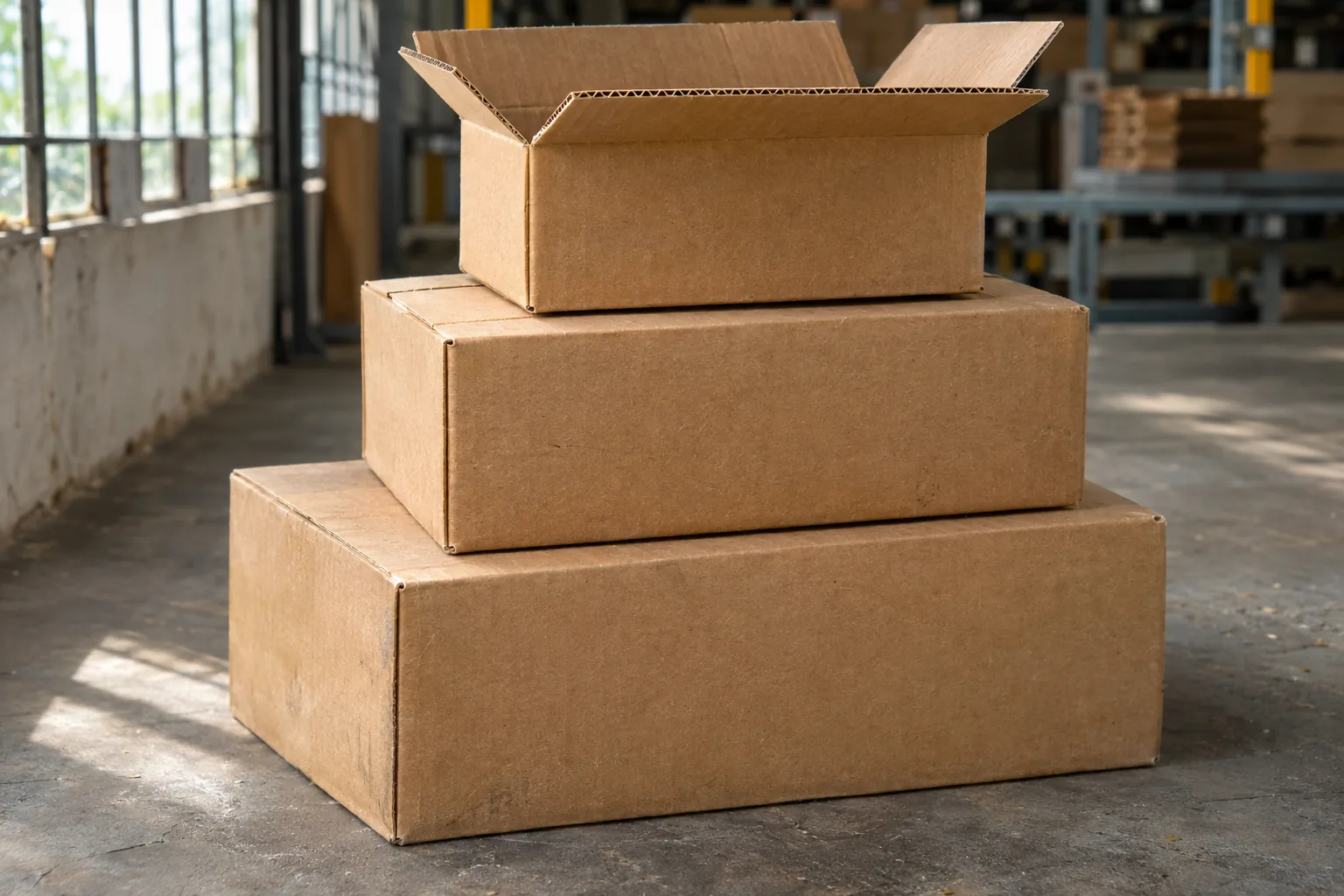
VantaPack manufactures custom RSC (regular slotted container) shipping boxes in 32, 44 and 48 ECT single or double wall board, with internal dimensions from 60 mm to 1,800 mm and 1–4 colour water-based flexo printing. Minimum order is 5,000 pieces per size; production lead time is 12–15 working days, and an FBA-compliant 12×9×6 in box costs roughly $0.38–$0.65 per unit at 5,000 pieces FOB Shenzhen.
What an RSC is, and why it dominates export shipping
A regular slotted container is a one-piece box with four flaps of equal width, cut from a single blank. The two outer flaps meet at the centre of the box top; the two inner flaps fold underneath. Because every flap is the same width — half the box depth — the blank wastes almost no board, and the box can be erected with one piece of tape in under three seconds.
That economy is why RSC accounts for roughly 80% of all corrugated containers shipped worldwide. There is no glue line, no stitching, no assembly labour at your warehouse: it arrives flat, opens square, and closes with tape. For palletised freight it also stacks predictably, because the vertical flutes run continuously around all four walls.
The trade-off is that an RSC is not a display box and not a protective case. It is optimised for one job — moving a product safely between two warehouses — and it does that job at the lowest board cost per cubic metre. If your product needs shelf presence, look at die-cut printed boxes; if it weighs over 65 lb, look at triple-wall heavy-duty packaging.
RSC vs FOL vs five-panel folder
An RSC (FEFCO 0201) is the standard. A full-overlap slotted container (0203) has outer flaps that overlap completely across the top — around 15–25% more board, but noticeably stronger against puncture and better for printed surfaces that must stay unbroken. A five-panel folder (0411) wraps the product on all sides with a glued seam and is the better choice for tall, thin or awkwardly shaped items.
Choosing the board grade: ECT, Mullen, and what actually matters
Two grading systems coexist in the corrugated trade and they measure different things. ECT (Edge Crush Test) measures the stacking strength of the board in pounds per linear inch — it predicts how much weight the box can carry in a stack. Mullen (bursting test) measures resistance to puncture in pounds per square inch. Because ECT correlates far better with real-world stacking and is cheaper to run, most North American buyers now specify ECT, while Mullen (#200, #275, #350) still appears on legacy specs.
As a rough conversion: 32 ECT ≈ 200# Mullen, 44 ECT ≈ 275# Mullen, 48 ECT ≈ 350# Mullen, 61 ECT ≈ 350# double wall.
| Grade | Wall | Product weight per box | Stack height supported | Typical use |
|---|---|---|---|---|
| 32 ECT | Single | Up to 30 lb (14 kg) | 3–4 boxes | Parcel, DTC e-commerce, apparel |
| 44 ECT | Double | 30–50 lb (14–23 kg) | 5–6 boxes | Palletised freight, small appliances |
| 48 ECT | Double | 50–65 lb (23–29 kg) | 6–8 boxes | Export LCL, industrial components |
| 61 ECT | Double | 65–120 lb (29–54 kg) | 4–5 boxes | Heavy parts, bottled goods |
| 71 ECT+ | Triple | 120–150 lb (54–68 kg) | 3–4 boxes | Machinery (see heavy-duty line) |
Values assume a 24×18×18 in carton, 50% relative humidity, and a 30-day stacking period. Humidity is the most under-rated variable: board loses roughly 40% of its compression strength between 50% and 90% RH, which is why ocean freight in a humid container is harder on boxes than the same load in a dry warehouse.
Indicative box compression strength by grade. We run physical BCT compression tests for every new size before releasing production.
How to size an RSC correctly
Internal dimensions are what matter — the space inside the box once erected. Suppliers who quote external dimensions are either being careless or overcharging you, because external dimensions are always larger by twice the board thickness.
Measure your product at its widest point on each axis, including any overhang, handle or protrusion. Then add clearance:
- Rigid product, no cushioning: add 3 mm (1/8 in) per axis. Any more and the product shifts, which is worse than a snug fit.
- With bubble wrap or foam wrap: add 10–15 mm per axis, or measure the wrapped product directly.
- Fragile, with corrugated inserts: the insert thickness determines the clearance — typically 25 mm per axis.
- Books, flat goods: the depth should be the stack thickness plus 3 mm; too much depth causes the stack to slump.
Dimension order is always L × W × D, where length is the longer of the two base dimensions. Our quote form follows this convention, so a "12×9×6" box is 12 in long, 9 in wide and 6 in deep.
Free dimensional check
If you send us a product drawing or a photo with a ruler, we'll calculate the internal dimensions, recommend the board grade, and confirm whether the box fits a standard pallet footprint (1,200 × 1,000 mm or 48 × 40 in). No charge, no obligation.
Printing, branding and the cost of colour
Flexo printing applies water-based ink directly to the corrugated board using a photopolymer plate. It is fast, cheap and durable — but it prints on a surface with visible flute lines, so fine detail and photographic gradients are limited. There are three realistic routes:
| Method | Colours | Cost premium | Best for |
|---|---|---|---|
| Plain (unprinted) | 0 | Baseline | FBA over-box, internal transfer, pallet loads |
| 1-colour flexo | 1 | +$0.04–$0.09/unit | Logo + part number + handling icons |
| 2-colour flexo | 2 | +$0.08–$0.16/unit | Brand mark plus a second accent or instruction panel |
| 4-colour flexo | 4 | +$0.16–$0.32/unit | Bold graphics, large solid areas, retail-adjacent |
| Litho-laminated | CMYK + spot | +$0.35–$1.10/unit | Photographic imagery — see printed boxes |
Print plates cost $60–$140 per colour per size, charged once. Practical advice from fourteen years of running these jobs: one colour printed well beats four colours printed cheaply. The brands that look most professional on a corrugated box use a single strong ink colour, a clear logo, and a handling instruction panel on the same plate.
Always include these on the print: "THIS SIDE UP" arrows, a fragility mark if relevant, your SKU in large type, and a box-recycling symbol. Warehouse staff scan for SKUs, not brand names — a box that is hard to identify gets opened, which slows receiving and increases damage claims.
What an RSC actually costs, broken down
Four variables drive the unit price. Understanding them lets you negotiate intelligently instead of asking for "a better price".
| Quantity | 32 ECT | 44 ECT | 48 ECT |
|---|---|---|---|
| 5,000 pcs | $0.38–0.65 | $0.55–0.82 | $0.68–0.95 |
| 10,000 pcs | $0.32–0.58 | $0.49–0.72 | $0.60–0.85 |
| 20,000 pcs | $0.31–0.52 | $0.46–0.68 | $0.56–0.80 |
| 50,000 pcs | $0.26–0.45 | $0.40–0.60 | $0.50–0.72 |
The gap between the low and high end of each band reflects blank area, board availability at the time of order, and whether the size falls on a standard sheet. Two sizes with the same volume can differ 30% in price if one cuts from a standard 1,400 × 2,800 mm sheet with 4% waste and the other wastes 22%. This is the single most useful cost lever and almost nobody tells buyers about it: let us adjust your dimensions by 10–20 mm and we can often cut from a nesting-friendly sheet, saving 15–25%.
Freight is usually the bigger number
Flat-packed RSC cartons are extremely freight-efficient — a 40ft HC container holds roughly 25,000–35,000 unassembled 12×9×6 boxes. At that density the ocean cost per box is $0.01–$0.03, which is why Chinese corrugated is competitive on the US East Coast even after 28 days of transit. The cost only breaks down when a box is too large to flat-pack efficiently or when the order is under 8 cubic metres, at which point LCL consolidation charges dominate the landed price.
Amazon FBA and retail compliance
Amazon's packaging requirements are unforgiving and are the most common reason a shipment gets marked unfulfillable. If you sell on FBA, specify these at the quote stage:
- Correct ECT for the weight tier. Over-boxes must withstand the Amazon ISTA-6 drop sequence. A 32 ECT box holding 40 lb will usually fail; you need 44 ECT.
- 2-inch clearance on at least three sides for the FNSKU label — build this into the artwork, not the box size.
- No staples, no exposed tape edges, no protruding flaps. Amazon rejects cartons that can snag on conveyor equipment.
- Suffocation warning label if the poly bag inside is 5 inches or larger.
- Box weight under 50 lb unless it is a single oversized item, in which case the "Team Lift" label applies.
We supply ISTA-3A drop test reports and can arrange ISTA-6 testing for SIOC (ships in own container) projects. For SIOC the box must pass the full Amazon drop sequence without any over-box — that typically requires ECT 48 minimum plus internal cushioning, and we'll engineer it with you rather than promise it blind.
Related reading
The corrugated materials guide covers flute profiles, liner grades and how humidity affects compression strength. For a full comparison of container styles, see the capabilities page. If your product weighs more than 65 lb, the heavy-duty packaging page explains when triple wall beats double wall.
Specifications
| Structure | Regular slotted container (FEFCO 0201). Half-slotted (0200), full-overlap (0203) and five-panel folder (0411) available on request. |
| Board grade | 32 ECT single wall · 44 ECT double wall · 48 ECT double wall. 200# / 275# / 350# Mullen test liner equivalents. |
| Wall thickness | Single wall 3.0–4.0 mm · Double wall 6.0–8.0 mm |
| Internal dimensions | 60 mm to 1,800 mm on any axis (2.4 to 71 in) |
| Dimensional tolerance | ±1.5 mm on score-to-score and slot-to-score |
| 1–4 colour water-based flexo, direct to board. Max print area 1,200 × 2,400 mm. Line and halftone (65 lpi) supported. | |
| Minimum order | 5,000 pcs per size · 1,000 pcs trial for plain (unprinted) cartons |
| Tooling | Die $180–$420 one-off, never re-charged. Stock sizes have no tooling cost. |
| Production lead time | 12–15 working days for stock board · 15–18 working days for custom board grades |
| Incoterms | FOB Shenzhen, CIF, or DDP to US, UK, Canadian and Australian addresses |
| Compliance | ISTA-3A drop test report supplied per shipment · Amazon FBA over-box compliant · FSC fibre available |
| Packing | Flat-packed, 20–25 boxes per bundle, stretch-wrapped and corner-protected on standard 1,200 × 1,000 mm pallets |
Board construction comparison. Single wall is three layers (liner–flute–liner); double wall adds two more; triple wall is seven layers.
RSC shipping box FAQ
What is the difference between RSC and a standard shipping box?
They are the same thing. RSC stands for regular slotted container, which is the industry name for what most people call a standard shipping box. The defining feature is four flaps of equal width cut from a single blank, with no glue line, so the box arrives flat and closes with one strip of tape.
What's the cheapest quantity to order?
Unit price continues falling until about 50,000 pieces, but the steepest drop happens between 5,000 and 20,000 pieces. Below 5,000 the per-unit cost is dominated by machine set-up and plate charges; above 50,000 the savings are marginal. Most of our recurring customers order 5,000–20,000 pieces per size per run.
Can you match a box I'm already buying locally?
Yes. Send the internal dimensions, board grade and a photo of the box, or ship us a physical sample. We reverse-engineer the die line, confirm the board grade by measuring caliper and ECT, and quote a like-for-like replacement — usually 30–45% below US sheet-plant pricing at equivalent volume.
Do you print inside the box?
Yes, either by printing on the inside liner before the corrugator combines the board, or by running a second flexo pass after die-cutting. Inside printing adds $0.05–$0.14 per unit and is worth it for unboxing experience on subscription and gift products.
How do I know the boxes will arrive undamaged?
Every shipment is packed flat in bundles of 20–25, stretch-wrapped, corner-protected and palletised to a 1,600 mm maximum height. We photograph the finished pallet and share the loading photos with you before the container seals. Damage rate across our 2025 shipments was 0.4%, and we cover freight damage under our DDP terms.
What is the minimum order for a custom size?
5,000 pieces per size. For a trial we accept 1,000 pieces on plain (unprinted) cartons so you can validate fit and strength before committing to full production. Custom sizes need a die, quoted at $180–$420 depending on complexity, charged once and never repeated on reorders.
Related pages
Corrugated Materials Guide
Flute profiles, ECT vs Mullen, liner grades and humidity effects.
Die-Cut & Printed Boxes
When you need litho print and a retail-ready structure.
Heavy-Duty Packaging
Triple wall and honeycomb for loads over 65 lb.
Factory Capabilities
Equipment list, QC process and inspection standards.
Amazon FBA Packaging Guide
The full compliance checklist, box by box.
Corrugated Box Pricing
What drives cost, and how to structure an order.
Send internal dimensions. Get board grade plus price tomorrow.
Tell us L × W × H, product weight, quantity and print colours. We'll confirm the ECT you actually need and return an itemised quote — no account, no sales calls.