Die-cut & printed corrugated boxes for retail and unboxing
When the box is part of the sale — subscription, cosmetics, electronics, retail shelf — print quality and structure matter as much as protection. We produce litho-laminated retail cartons and flexo-printed die-cut boxes with registration tight enough for big-box and e-commerce requirements.
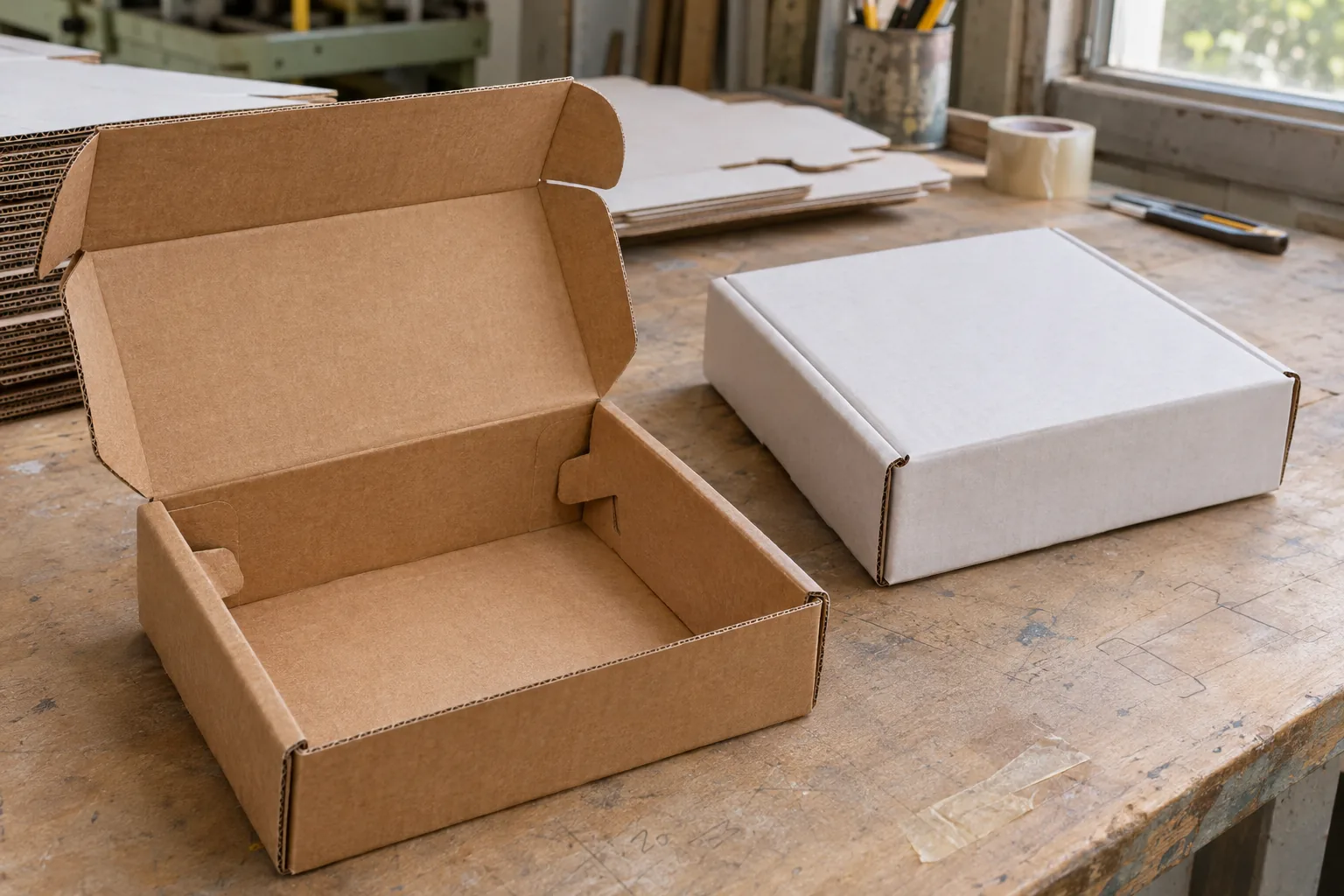
VantaPack manufactures die-cut and printed corrugated boxes using CMYK litho-laminated E-flute or 1–4 colour water-based flexo directly on B/C-flute board. Minimum order is 5,000 pieces per size. Production lead time is 18–22 working days from approved artwork, and finishes include spot UV, soft-touch lamination, hot foil, embossing and debossing.
Litho-lamination vs. direct flexo print
The first decision is whether to print on the corrugated board directly, or to laminate a pre-printed sheet onto the flute. Each route changes the cost, quality and minimum order.
| Method | MOQ | Best imagery | Surface finish | Lead time |
|---|---|---|---|---|
| Direct flexo | 5,000 pcs | Logos, line art, bold solids | Visible flute texture | 16–20 days |
| Litho-lamination | 5,000 pcs | Photography, gradients, fine detail | Smooth, premium paper face | 20–24 days |
| Hybrid pre-print | 5,000 pcs | High-volume retail graphics | Direct-print smooth liner | 18–22 days |
Direct flexo is cheaper and faster, but the flute lines show through and 4-colour process is limited to 65–85 lpi screen ruling. Litho-lamination gives you offset-quality CMYK, spot Pantone, and a clean paper surface for special finishes — but it adds roughly 30–45% to material cost and raises the MOQ. For most subscription and cosmetics projects, litho-lam is the better impression.
What retail buyers actually require
If you are selling through a retail partner — Amazon, Target, Walmart, Home Depot — the box has to pass receiving standards before it reaches a customer. These are the most common failure points:
- Shelf-ready packaging (SRP): perforations must tear cleanly, the tear panel must expose the product without damaging the display, and the box must stand unsupported for the shelf life.
- Barcode grade: we print barcodes to ISO/IEC 15415 Grade C or better. A Grade D barcode is the fastest reason a shipment gets rejected at a DC.
- Colour consistency: we keep master samples and ink recipes per SKU so a re-order six months later matches the original run within ΔE 1.5.
- Weight limits: a retail-ready display with product inside often weighs 20–40 lb. We size the flute and double-wall configuration to keep deflection under 5 mm over 30 days.
- SIOC / ships in own container: if Amazon requires the product to ship without an over-box, the printed carton must pass ISTA-6. This usually means ECT 48 plus internal cushioning, not just a pretty box.
Finishes that change how a box feels
Print is only part of the impression. The coating or lamination controls perceived value:
- Soft-touch lamination: a velvety matte film. Common for beauty, premium spirits and gift sets. Adds roughly $0.18–$0.42 per unit depending on area.
- Anti-scratch matte BOPP: protects the print through warehouse handling and looks better after transit than standard gloss.
- Spot UV: a gloss varnish applied only to logos or key artwork areas, creating contrast against a matte background.
- Hot foil / cold foil: metallic gold, silver or holographic effects. Hot foil is sharper and more durable; cold foil is cheaper for large areas.
- Emboss / deboss: raises or presses the paper surface for tactile brand marks. Best combined with soft-touch lamination.
What drives the price of a printed box
A printed box costs more than an RSC because every extra process adds labour, drying time and inspection. The major levers, in order of impact:
- Board construction — E-flute litho-lam costs 25–40% more than B-flute flexo direct.
- Print coverage and colours — full CMYK + a Pantone spot on every panel increases ink and plate cost.
- Finishing steps — each lamination, UV or foil pass is a separate station.
- Die complexity — boxes with locking tabs, windows and handles need more die rules and slower run speeds.
- Quantity — at 20,000+ pieces the per-unit setup charge becomes small; below 5,000 it dominates.
Practical example
A 10×8×3 in E-flute litho-laminated mailer, CMYK + soft-touch lamination + spot UV logo, at 5,000 pieces: approximately $1.45–$1.95 per unit FOB Shenzhen. The same box in 1-colour flexo direct on B-flute: approximately $0.72–$0.98 per unit.
Specifications
| Structure | Die-cut self-locking mailers, tuck-end boxes, gable boxes, handle carriers, hexagonal and retail display units. Any FEFCO or custom structure. |
| Board grade | E-flute (1.5 mm) for litho-lam · B-flute (3.0 mm) or C-flute (4.0 mm) for flexo direct print · BC double wall for heavier retail loads. |
| Print methods | CMYK + spot Pantone litho lamination; 1–4 colour water-based flexo; hybrid flexo + pre-print liner. |
| Print registration | ±0.3 mm litho-to-die; ±1.0 mm flexo print-to-die |
| Internal dimensions | 50 mm to 1,200 mm on any axis |
| Finishing | Spot gloss/matte UV, soft-touch/anti-scratch lamination, hot foil, cold foil, blind emboss/deboss, window patching, tear strip. |
| Minimum order | 5,000 pcs per size · Trial samples 1,000 pcs |
| Tooling | Die $220–$520 one-off; print plates / litho film $90–$180 per colour; cylinder charge for lamination. All tooling stored free for reorders. |
| Production lead time | 18–22 working days after artwork approval; 5–7 day pre-production sample. |
| Colour proofing | Digital contract proof, press proof or pre-production sample; Pantone match to ±1.5 dE on solid colours. |
| Compliance | FSC-certified paper available; Toy Safety EN 71-3 compliant inks on request; Amazon SIOC structure review. |
| Packing | Flat-packed in bundles, shrink-wrapped and palletised; can ship pre-assembled for display units. |
Board construction comparison. Litho-lamination typically uses E-flute; flexo direct print commonly uses B-flute or C-flute.
Die-cut and printed box FAQ
What is the difference between litho-lamination and flexo printing?
Litho-lamination prints CMYK artwork onto a separate paper sheet, then glues that sheet onto corrugated E-flute. It gives smooth, photo-quality results and supports spot Pantone and special finishes. Flexo prints water-based ink directly onto the corrugated board; it is faster and cheaper but shows flute texture and supports simpler graphics.
Can you match a Pantone colour exactly?
Yes. We mix Pantone inks to the formula guide and confirm colour on a contract proof or pre-production sample. Typical tolerance is ΔE 1.5 for solid Pantone areas. Metallic and pastel colours may have a slightly wider tolerance due to substrate absorption.
What is the minimum order for a printed box?
5,000 pieces per size across direct flexo, litho-lamination and hybrid pre-print. Trial samples start at 1,000 pieces. Tooling and plate costs are charged once and stored free for reorders.
Can you print inside the box?
Yes. Inside printing is available on both flexo and litho-laminated boxes. It is popular for subscription and gift unboxing. Inside print adds roughly $0.05–$0.18 per unit depending on coverage.
Do printed boxes cost more to ship?
Printed boxes ship flat exactly like plain boxes, so freight cost per unit is similar. The only shipping consideration is that laminated boxes are slightly stiffer and may need a higher pallet to avoid edge damage during ocean transit.
Can you make retail-ready packaging with tear-away panels?
Yes. We engineer SRP structures with clean tear perforations, Euro hook holes and shelf-ready display fronts. We can also pre-load product into the display and ship it pallet-ready if you provide packing instructions.
Related pages
RSC Shipping Boxes
Standard slotted containers for freight and FBA.
Heavy-Duty Packaging
Triple wall and honeycomb for heavy loads.
E-Commerce Mailer Boxes
Self-locking mailers with tear strips.
Corrugated Materials Guide
Flute profiles, ECT and liner grades.
Amazon FBA Packaging
ISTA-6 and SIOC requirements.
Request a Quote
Upload artwork and get a price within one business day.
Upload your artwork. Get a litho or flexo quote tomorrow.
Send dimensions, target quantity, artwork (AI/PDF), and whether you need litho-lamination or flexo. We'll recommend the board grade, finishing sequence and lead time.