Key takeaways
- BCT is a lab peak on a fresh box. Working stack load is roughly 25–40% of it.
- The McKee formula estimates BCT from ECT, caliper and perimeter — ECT is linear, caliper sits under the square root.
- Humidity costs up to 50%. Creep costs about 45% over 90 days. The two multiply.
- Interlocked pallet patterns lose 49–54% of compression strength against the single-box BCT.
- Flute direction is free to check and the most common cause of crushing.
- Specify by gross carton weight, stack height, storage duration and humidity — not by ECT alone.
Two numbers, one box
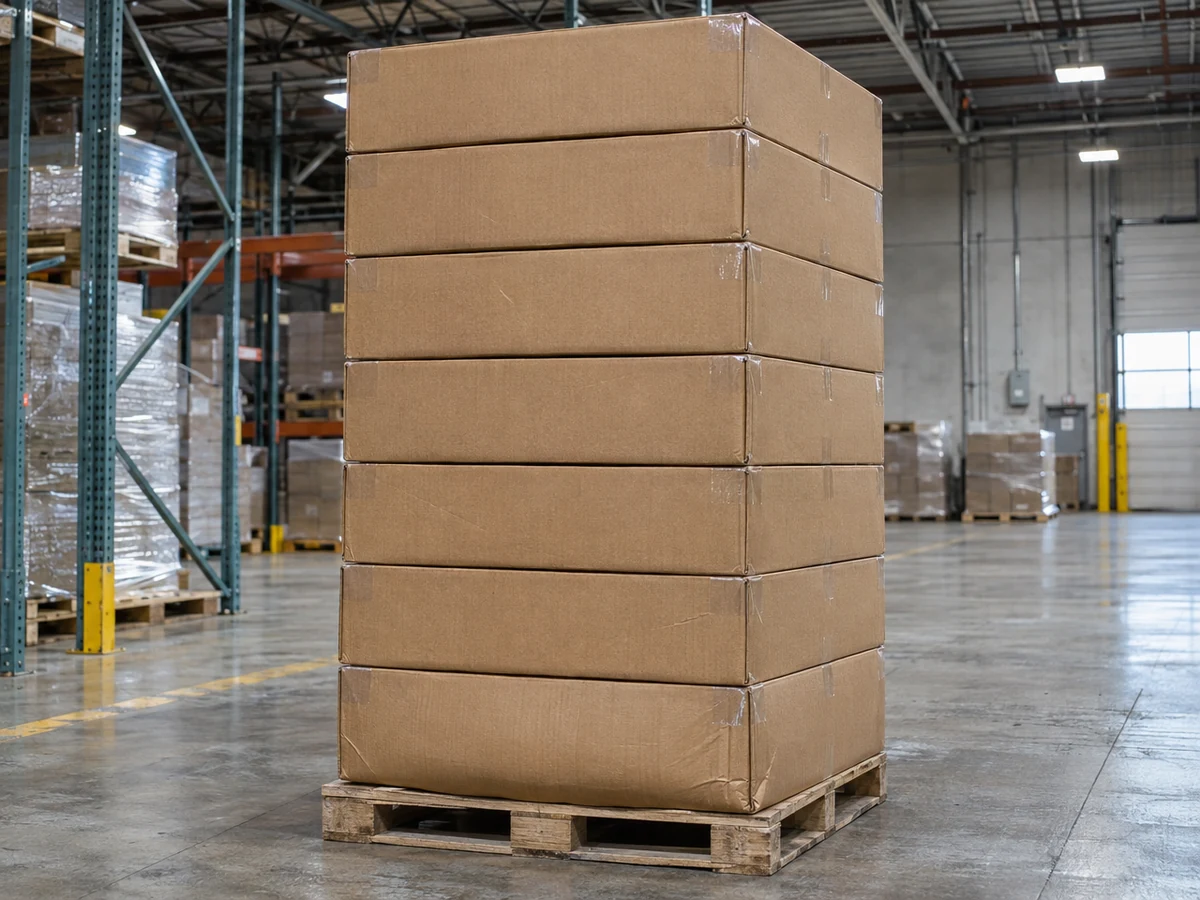
Two numbers describe the strength of a corrugated box, and buyers routinely confuse them.
The first is ECT, the Edge Crush Test. It is a property of the board, not the box. A strip of corrugated is stood on edge and crushed between platens, and the result is reported in pounds per linear inch or kilonewtons per metre. ECT is what appears on the Box Maker's Certificate, and it is what most purchase orders specify.
The second is BCT, the Box Compression Test. It is a property of the finished box. An empty, closed, erected box is crushed between platens until its walls buckle, and the peak force is recorded in newtons or kilograms-force. BCT is what actually determines whether the stack holds.
The difference matters because ECT does not change when you change the box size, and BCT does. Take the same 44 ECT board and make a small box and a large box. The ECT is identical. The BCT is not: the large box has longer unsupported panels and buckles at a lower load. This is why two suppliers can both quote "44 ECT" and deliver boxes with very different stacking performance.
The McKee formula
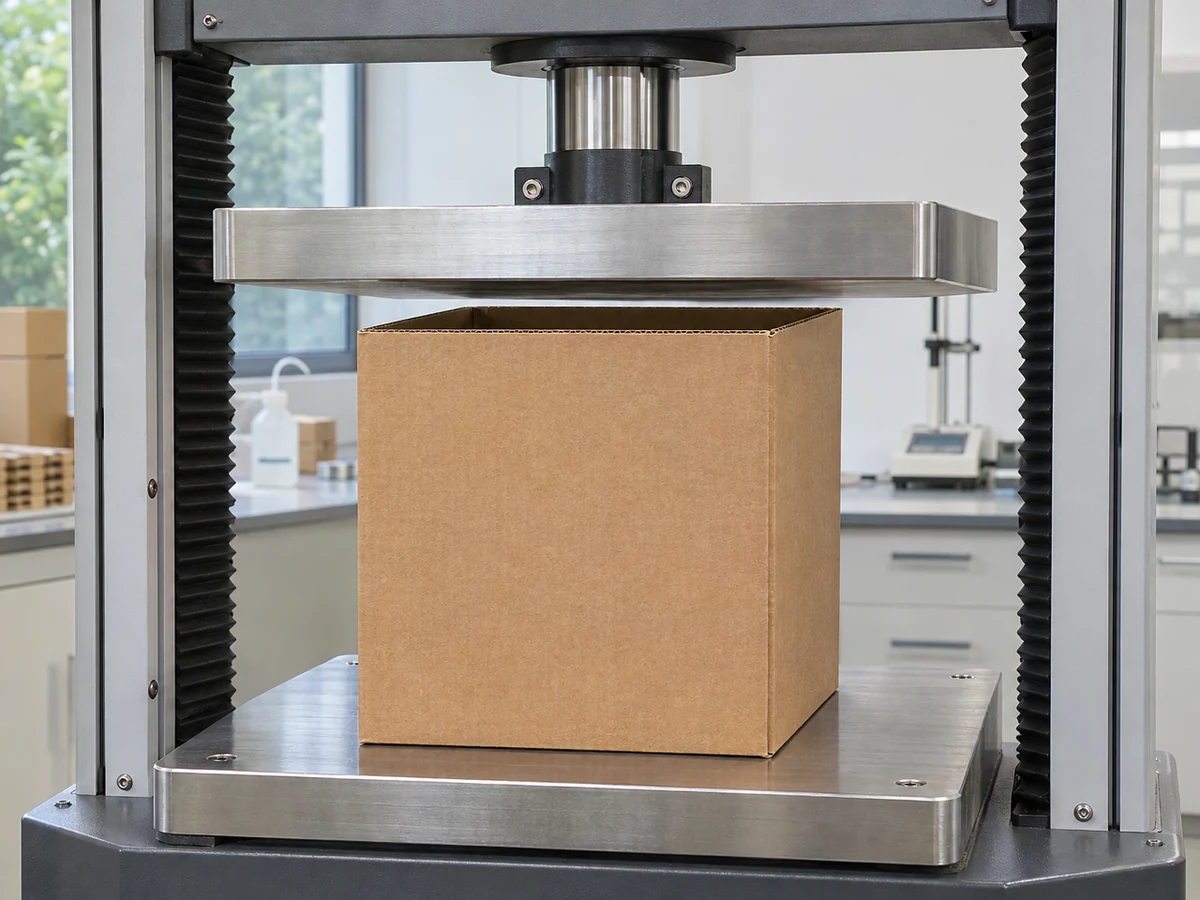
The relationship between board strength and box strength was published by McKee, Gander and Wachuta in 1963 and is still the working estimate used across the industry. In its simplified metric form:
BCT (N) = 5.87 × ECT (kN/m) × √( caliper (mm) × perimeter (mm) )
perimeter = 2 × (length + width)
Read the exponents, because they tell you which lever is worth pulling. ECT enters the equation linearly: a 30% stronger board gives a 30% stronger box. Caliper sits under the square root: doubling board thickness gives only about 41% more BCT. Perimeter also sits under the square root, which means a bigger box is weaker — doubling the perimeter of the base buys only 41% more strength to spread over twice the wall area.
| Board | ECT | Caliper | Estimated BCT | Working load at factor 4 |
|---|---|---|---|---|
| Single wall, B-flute | 4.5 kN/m | 3 mm | ≈ 2,240 N (228 kgf) | ≈ 57 kgf |
| Single wall, C-flute | 6.5 kN/m | 4 mm | ≈ 2,855 N (291 kgf) | ≈ 73 kgf |
| Single wall, C-flute, high ECT | 8.5 kN/m | 4 mm | ≈ 3,735 N (381 kgf) | ≈ 95 kgf |
| Double wall, BC-flute | 9.0 kN/m | 7 mm | ≈ 4,490 N (458 kgf) | ≈ 114 kgf |
Perimeter fixed at 1,400 mm. The working load column applies a flat factor of 4, which is a rough approximation — the next two sections show why the real factor depends on your route and your pallet pattern.
Five things that shrink BCT
A BCT figure is measured on a fresh box, crushed once, over a few minutes, in a conditioning room at 23 °C and 50% relative humidity. A warehouse is not a conditioning room. Five effects remove strength between the lab and the pallet.
1. Humidity
Corrugated is cellulose, and cellulose absorbs moisture that breaks the hydrogen bonds giving paper its stiffness. The loss is steep and non-linear. At 70% relative humidity board loses roughly 20% of its compression strength. At 80% the loss is 30 to 40%. At 90% it exceeds 50%. A carton specified for a dry warehouse and then shipped through a humid ocean crossing arrives at a fraction of the strength it was bought for.
2. Time under load (creep)
Even in dry conditions, paper fibres slowly deform under constant weight. The fibres relax, the panels bow progressively, and a box that survives a five-minute lab test can buckle after three weeks in a stack. The Fibre Box Association's storage-under-load multipliers put the loss at about 40% after 30 days, 45% after 90 days and 50% after 180 days. Long-term usable strength is commonly taken as 50 to 60% of peak BCT.
3. Pallet pattern
This is the largest single factor and it gets a section of its own below. In short: an interlocked pattern removes corner alignment, and the corners are where a corrugated box carries its load.
4. Overhang and deck gaps
Cartons that overhang the pallet edge lose 20 to 40% of their compression strength, because the unsupported corner acts as a lever against the wall. Gaps between pallet deck boards cost a further 10 to 25%, because the bottom carton's base is only supported in strips. Both are construction decisions that can be corrected at no material cost.
5. Handling and design features
Every hand hole, die-cut window, tear strip or heavy solid print area removes material that the McKee formula assumes is present. Excessive handling in a distribution centre costs a further 10 to 40%. None of these appear in the lab figure, and all of them appear in the failure.
Pallet pattern: the biggest single loss
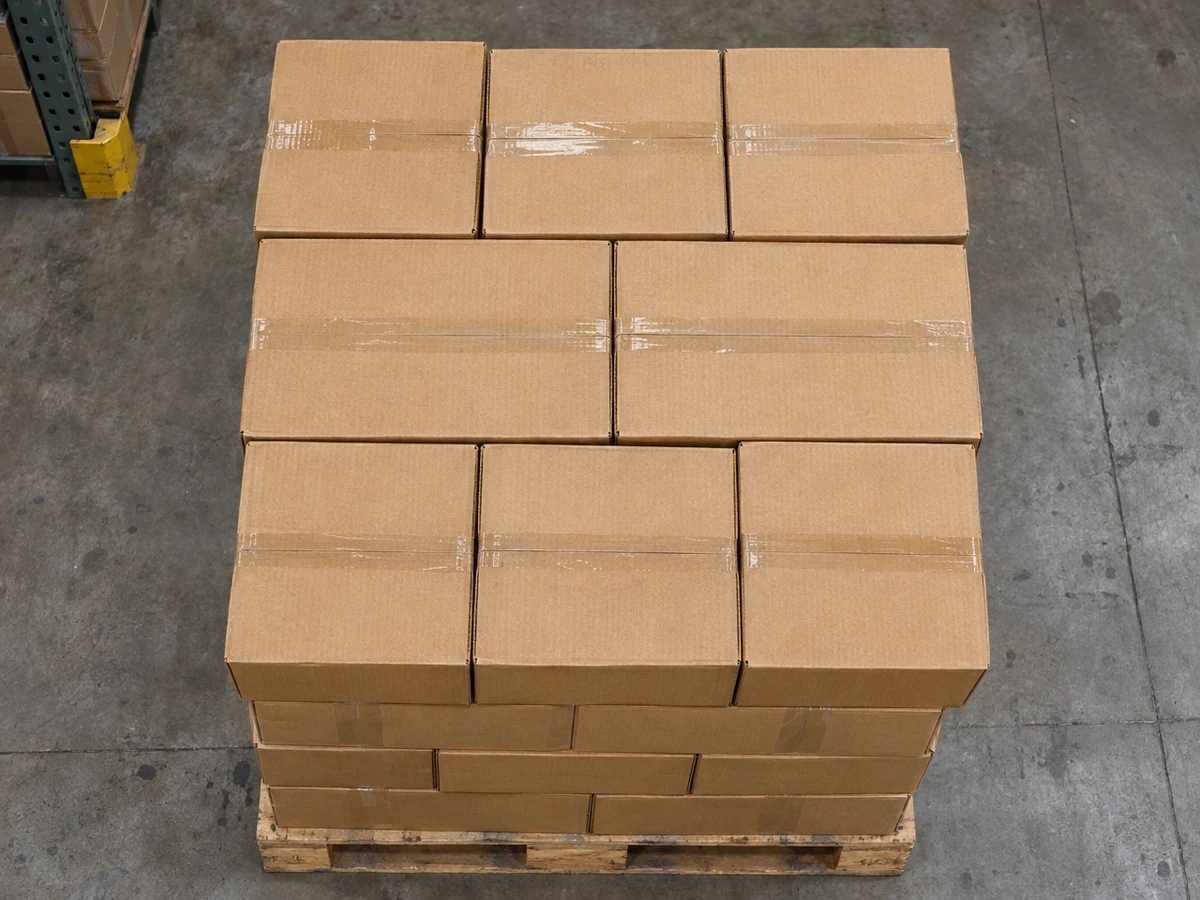
Corrugated boxes carry vertical load through their corners, which act as four columns transferring force from the top surface of the box to the surface below. Align the corners and the load passes straight down. Offset them and the load has to travel through the panels, which buckle.
The Fibre Box Association commissioned a unitisation study to quantify this properly, run at the Rochester Institute of Technology and published in 2021. It built 32 and 44 ECT single-wall C-flute RSCs at 19.5 × 13 × 12 in, loaded each with a plywood panel and a bag of salt to force failure to the bottom layer, conditioned them to TAPPI T402, and compression-tested whole unit loads in four stacking patterns.
| Pattern | 32 ECT loss | 44 ECT loss | Multiplier to use |
|---|---|---|---|
| Column aligned | 12% | 20% | 0.84 |
| Columnar misaligned (0.75 in offset) | 44% | 45% | 0.56 |
| Hybrid | 45% | 49% | 0.53 |
| Interlocked | 49% | 54% | 0.49 |
Source: Dunno and Ge, Influence of Pallet Pattern on Top to Bottom Compression Performance of Unitized Loads, Fibre Box Association unitisation project final report, revised May 2021.
Two findings are worth pausing on. First, interlocked stacking — the pattern most warehouses use by default because it is more stable on the pallet — costs roughly half of the box's compression strength. Second, the study found that columnar misalignment with a mere 0.75 in offset lost 44 to 45%, which is more than twice the 10 to 15% that older guidance suggested for the same pattern. If your pallet pattern is specified as "interlocked" and your board grade was calculated from a single-box BCT, the margin you think you have may not exist.
A worked stack calculation
The arithmetic is not complicated. It is just rarely done in full. Take a real case: 20 kg gross cartons, eight layers high on a pallet, double-stacked in a container, stored 90 days in a warehouse running around 80% relative humidity, interlocked pattern, no overhang.
| Step | Value | Running figure |
|---|---|---|
| Lab BCT, 32 ECT RSC, 400 × 300 mm | 291 kgf | 291 kgf |
| × Humidity at 80% RH | 0.65 | 189 kgf |
| × Creep, 90 days under load | 0.55 | 104 kgf |
| × Interlocked pallet pattern | 0.49 | 51 kgf |
| × Deck board gaps and handling | 0.85 | 43 kgf |
Required load: the bottom carton carries seven cartons above it, at 20 kg each, which is 140 kg. Add double stacking in the container and it also carries the upper pallet's timber and its full load — roughly another 25 kg of pallet plus 160 kg of cartons — so the worst case is around 325 kg.
Available: 43 kgf. Required: 325 kgf. The box fails by a factor of seven, and nothing in the board specification would have told you that. The lab number looked adequate. The stack was never designed.
The failure always surfaces late
The box that crushes is the bottom one, and it crushes in week three at the distribution centre — after the pallet has been built, after the freight has been paid, and after the goods have been promised to a customer. The damage claim arrives as "poor packaging" and the fix is quoted as a heavier board, when the actual causes were a pallet pattern, a humidity exposure and a storage duration that nobody wrote down.
Levers, in order of cost
When the arithmetic comes up short, the instinct is to order a heavier board. That is the most expensive lever and often not the first one that should be pulled. In order of cost per unit of strength gained:
- Check the flute direction. Flutes must run top-to-bottom so the corrugated columns sit vertically between the load and the pallet. Rotate a box so the flutes lie horizontally and it loses most of its compression strength regardless of ECT. This costs nothing to check and nothing to fix at the design stage.
- Switch to column stacking and sit cartons flush to the pallet edge. Going from interlocked to column aligned takes the multiplier from 0.49 to 0.84 — a 71% gain in available strength at no material cost. The trade is pallet stability, which is usually solved with stretch film or corner boards rather than by sacrificing strength.
- Remove overhang and deck gaps. A carton that overhangs by 25 mm loses 20 to 40%. Resizing the pallet footprint to the carton, or the carton to the footprint, is a design conversation, not a material one.
- Add internal columns. Corrugated partitions, honeycomb blocks or a moulded fitment that touches both the base and the lid share the load with the walls. This is the standard fix for a box whose product is lighter than its packaging, and it usually costs less than a board upgrade.
- Increase caliper: B-flute to C-flute, or single to double wall. Caliper sits under the square root in McKee, so moving from 3 mm to 4 mm adds only about 15% to BCT, while moving from 4 mm to 7 mm adds about 32%. Both cost fibre and cube.
- Raise ECT at constant caliper. ECT is linear in McKee, so this is a predictable gain, but it consumes liner and medium grammage. Ask the supplier whether the gain comes from the liner or the fluting medium — fluting medium lifts ECT more per dollar in most cases.
Only after all six are considered is a heavier board the right answer. Done in this order, the result is often a box that carries more load at the same or lower cost, because the strength was already in the material and the direction was wasting it.
What to put in the PO
Most stacking failures begin as a purchase order that specified ECT and nothing else. ECT tells the supplier which board to run. It does not tell anyone what the box has to survive. Add these six items and the conversation changes from a board grade to a design.
- Gross carton weight, packed, in kg
- Stack height and whether pallets will be double-stacked in a container
- Pallet pattern: column aligned, interlocked, or hybrid — and the pallet footprint
- Storage duration at the destination, from arrival to last pick
- Expected relative humidity range, or simply "unheated warehouse" versus "climate controlled"
- Any hand holes, windows, tear strips or large solid print areas on the panels that carry load
With those six, a supplier can compute a required BCT, choose a board grade that meets it with a stated safety factor, and tell you which of the six is costing you the most. Without them, the supplier can only quote ECT — and ECT, as the table above shows, is not the number that decides whether the stack holds.
One page, six numbers
If you can send those six figures, we can return the board grade, the predicted BCT and the working stack load for your route — with the derating for humidity, creep and pallet pattern shown separately so you can see which assumption is driving the answer. Start a stacking review, or send the pallet pattern drawing and we will work from that.