Key takeaways
- Direct flexo prints on corrugated board directly; tooling is low but each colour needs a plate.
- Litho-lam gives photo quality by laminating a printed sheet to the board; unit cost is highest.
- Digital inkjet skips plates and makeready; best for short runs, samples and variable data.
- Brown kraft dulls colours; full-colour graphics usually need white-top board or litho-lam.
- The crossover point is roughly 1,000 units for digital vs. litho, and 3,000–5,000 for flexo vs. litho.
- Specify the retail channel and artwork type, not just a print method name.
The three methods
Most custom corrugated cartons are printed one of three ways: direct flexographic printing on the finished board, lithographic lamination, or single-pass digital inkjet. Each has a different cost structure, quality ceiling and lead time, and the wrong choice is expensive in opposite directions.
Flexo looks cheap until you amortise plates over a short run. Litho-lam looks expensive until you see the shelf impact. Digital looks slow until you count the days saved on tooling. The goal is to match the method to the job, not to pick a favourite.
Direct flexographic post-print
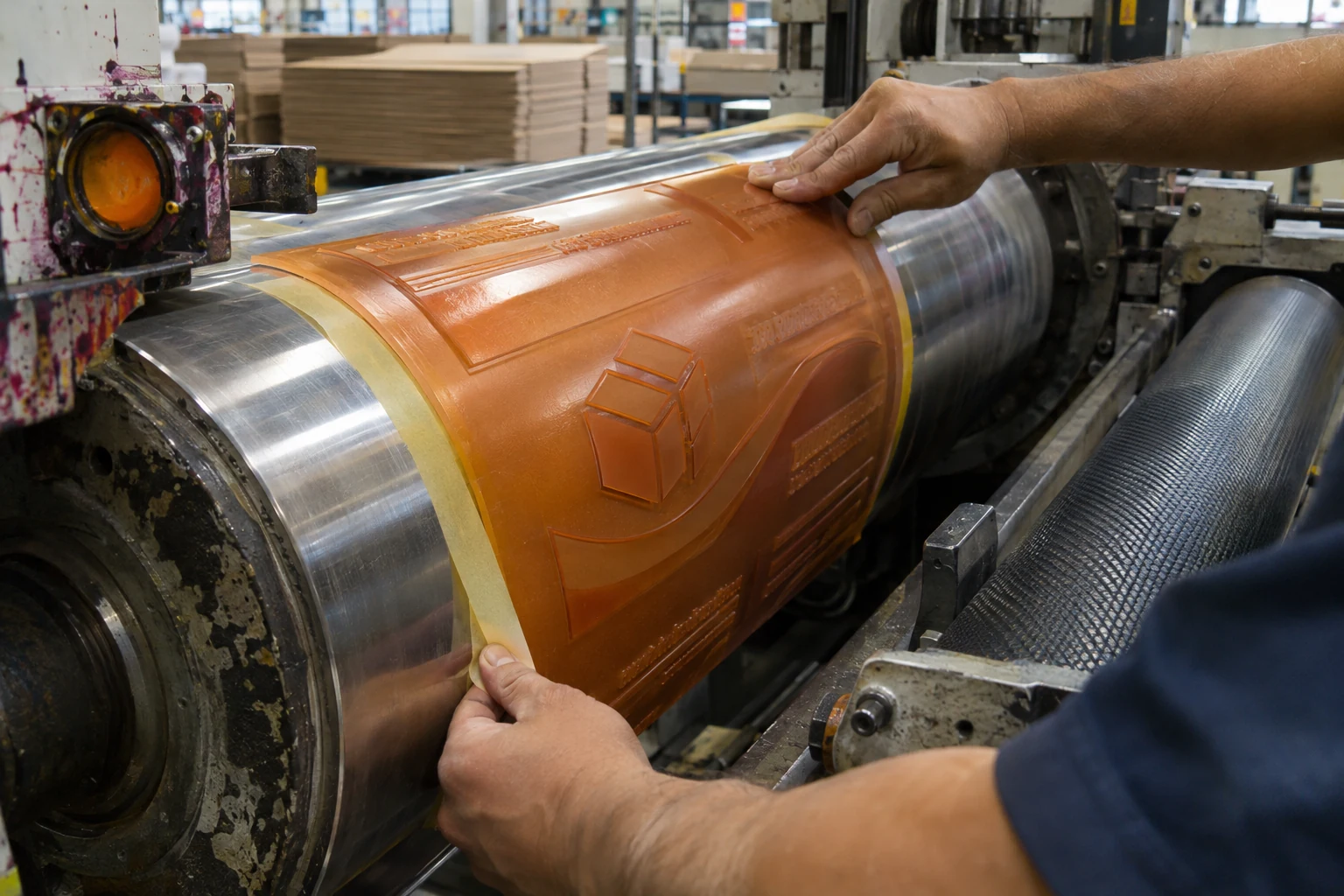
Flexo is the default for most corrugated. A flexible photopolymer plate is wrapped around a cylinder, inked by an anilox roller, and pressed against the board as it passes through the press. The board is then die-cut, folded and glued into a box.
Because it prints on already-corrugated board, it is sometimes called post-print. The corrugator can run standard board grades and the printer can switch jobs quickly, which is why flexo dominates shipping cartons and standard RSCs.
What flexo does well
- Low unit cost at volume. Once plates are made, the running cost is mainly ink and board.
- Fast lead times on repeat orders. Reorder with the same plates and the press is running in hours.
- Brown or white kraft. Works on standard liners without an extra substrate.
- Inline finishing. Printing, die-cutting, folding and gluing can happen on a single pass.
Where flexo struggles
- Flute show-through. Halftone dots land on flute crests and valleys, so solids and gradients can look uneven.
- Limited colour range on brown kraft. Colours absorb into the fibres and look muted; a white underprint is usually needed for bright graphics.
- Plate cost per colour. A four-colour job needs four plates. On a 500-unit run the plate cost can exceed the carton cost.
- Registration across large boards. As board size grows, slight stretch makes tight registration harder.
Flexo is the right method for a brown RSC with a one- or two-colour logo, for shipping marks, or for any carton where the print is functional rather than promotional. It is also the right method for high-volume e-commerce mailers in FEFCO 0713 or similar self-locking styles, where the print is usually a simple brand mark and a few handling instructions.
Litho-lamination
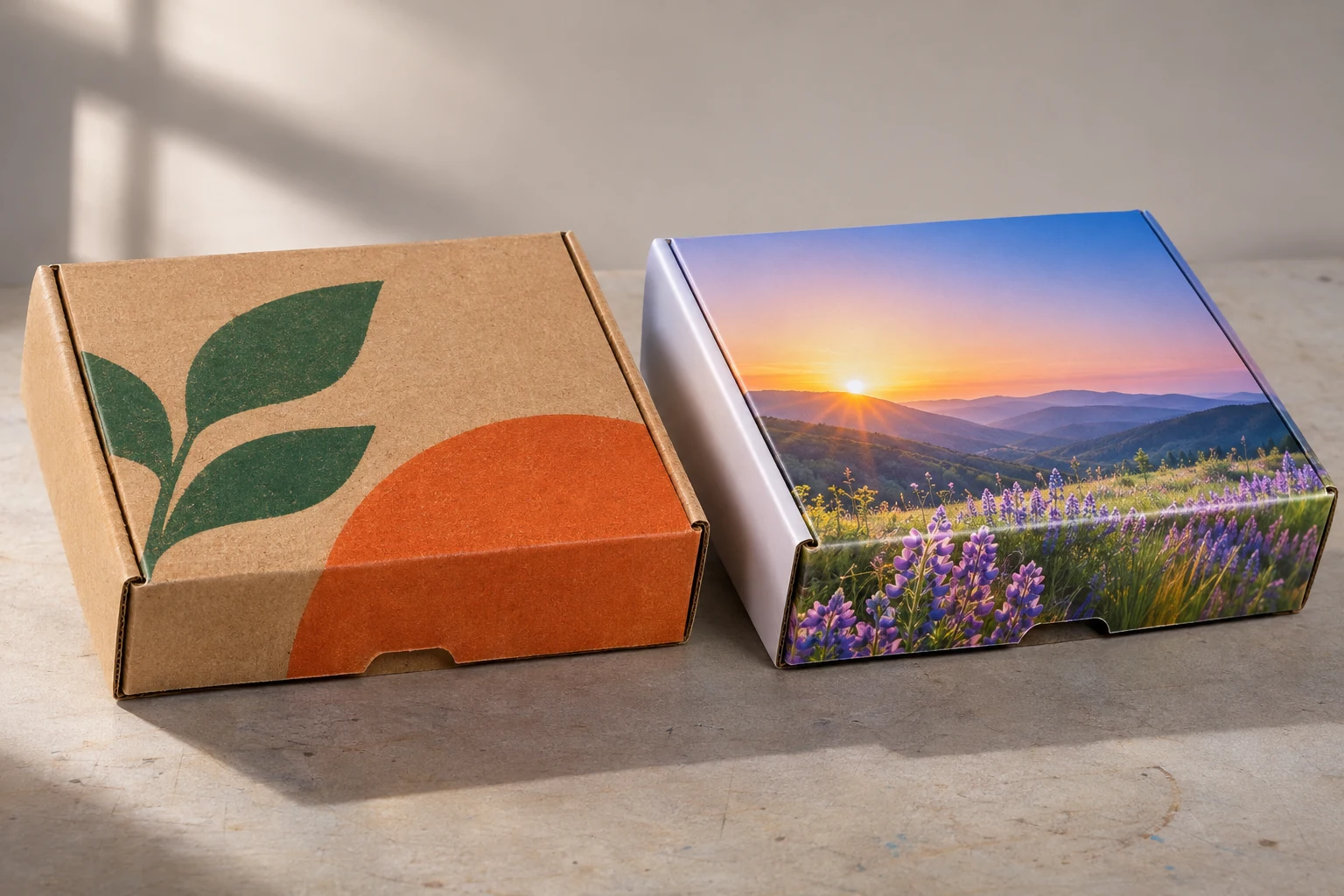
Litho-lamination separates the printing from the corrugating. A high-quality lithographic press prints on a smooth paper sheet, which is then laminated to the corrugated board. The result is a white, flat surface with magazine-quality colour, fine halftones and clean gradients.
It is the closest thing corrugated has to folding-cartoon quality, and it is what you see on premium retail packaging, gift sets, cosmetic cartons and shelf-ready display boxes.
What litho-lam does well
- Photo-quality graphics. Fine detail, skin tones, gradients and metallic effects are all achievable.
- White base. The laminated sheet is already white, so colours stay bright without a separate underprint.
- Premium feel. Gloss, matte and soft-touch finishes can be applied before lamination.
- Retail shelf impact. The print surface is smooth enough for spot UV, foil stamping and embossing.
Where litho-lam struggles
- Unit cost. You are paying for a printed sheet plus adhesive plus lamination.
- Lead time. The sheet is printed separately, then laminated, then converted — three stages instead of one.
- Recyclability notes. Most paper-based adhesives are repulpable, but some films and coatings can downgrade recyclability. Ask for the adhesive specification if sustainability claims matter.
- Not for plain shipping cartons. The cost is hard to justify when the carton is hidden in an outer case.
Specify litho-lam when the carton is part of the product experience: subscription boxes, retail-ready trays, gift packaging and display stands. Do not specify it for a standard shipping carton unless the marketing team is paying for it.
Digital inkjet
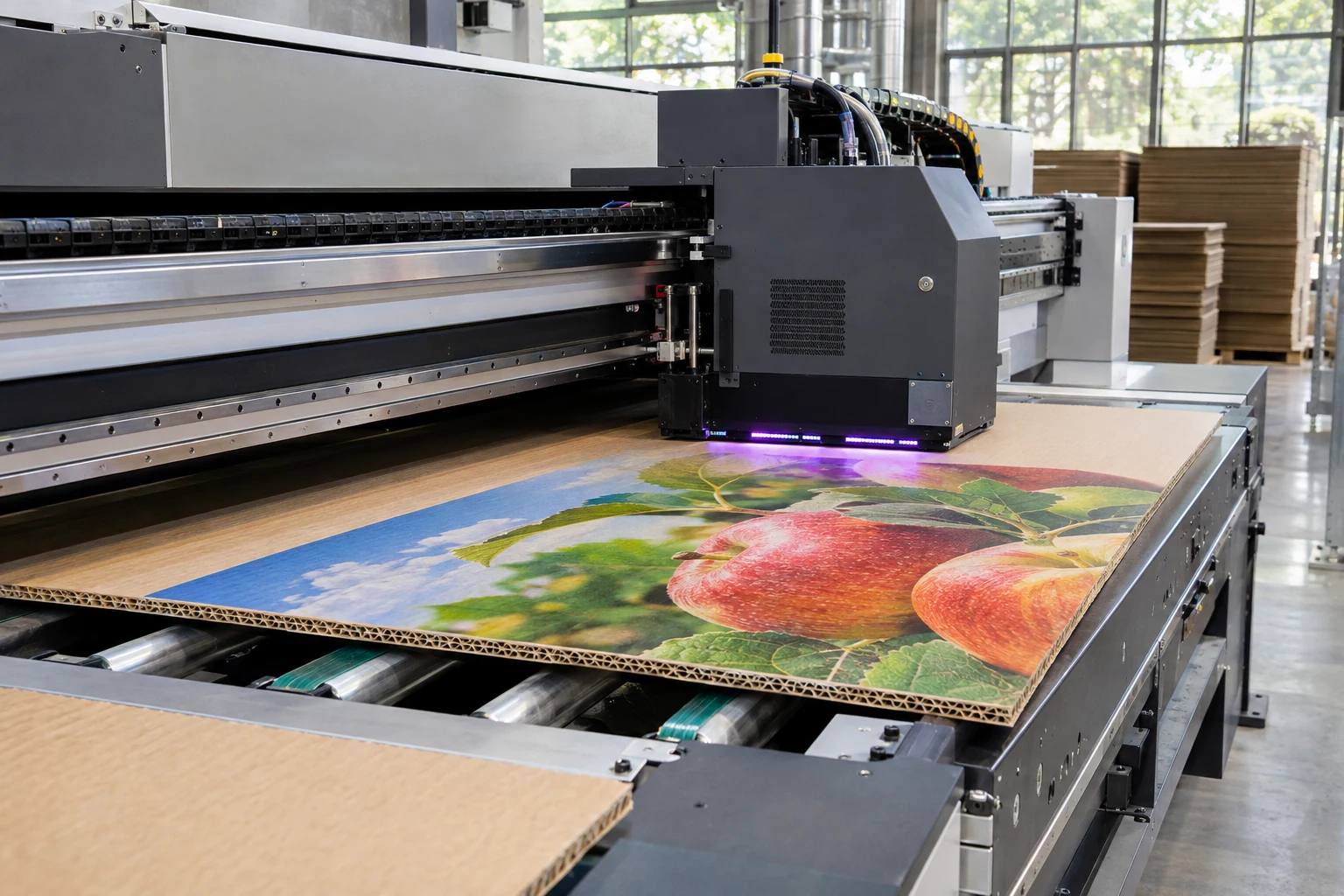
Single-pass digital inkjet presses print CMYK — sometimes plus white or orange — directly onto corrugated board from a digital file. There are no plates, no cylinder changes and almost no makeready.
This changes the economics at the short end. A run of 200 units with four versions is economic in digital because the setup cost is near zero. The same job in flexo would need four plates per version and a mountain of makeready board.
What digital does well
- No tooling. Artwork changes cost nothing but file preparation.
- Versioning and personalisation. Every sheet can be different: SKU codes, language variants, promotional messages.
- Samples and prototypes. See the finished box before committing to plates.
- Fast turnaround. A file approved today can print tomorrow.
Where digital struggles
- Ink cost per unit. Digital ink is more expensive per square metre than flexo ink, so unit cost rises with coverage.
- Speed ceiling. Even single-pass presses are slower than flexo on long runs.
- Board surface. Like flexo, it prints on corrugated board, so flute texture can show in large solids.
- Colour matching. Pantone spot colour matching is improving but still less predictable than mixed flexo ink.
Digital is the right method for short runs, seasonal promotions, market tests, influencer kits and any programme where the artwork changes frequently. It is also useful as a bridge: print digitally for launch, then switch to flexo once volumes justify plates.
Comparison at a glance
| Factor | Direct flexo | Litho-lam | Digital inkjet |
|---|---|---|---|
| Typical MOQ | 3,000–5,000 pcs | 3,000–5,000 pcs | 100–500 pcs |
| Plate/tooling cost | Moderate per colour | Low (print plates only) | None |
| Unit cost at volume | Lowest | Highest | Medium–high |
| Print quality | Good for line art and solids | Photo quality | Very good, near litho in many cases |
| Best board | Brown or white kraft | White face via laminated sheet | Brown or white kraft |
| Colour capability | 1–6 spot or process | Full CMYK + spot/Pantone | CMYK, sometimes white or orange |
| Lead time | 7–14 days | 14–21 days | 3–7 days |
| Variable data | No | No | Yes |
| Inline finishing | Yes | No | Limited |
| Ideal use | Shipping cartons, simple mailers | Retail, premium, display | Short runs, samples, versioning |
Figures are typical for export-oriented corrugated converters and vary with press width, board size and coverage. Treat them as decision thresholds, not quotes.
Where the costs cross over
The cheapest method depends on how many units the tooling cost is spread over. The curves are roughly:
- Below 1,000 units: Digital is usually cheapest because there are no plates.
- 1,000–3,000 units: Digital and litho-lam compete; flexo may win if the artwork is one or two colours.
- 3,000–5,000 units and above: Flexo becomes the low-cost option for simple to moderate graphics.
- High-volume retail: Litho-lam or pre-print can beat flexo-lam because the print quality reduces returns and improves shelf velocity, even at higher unit cost.
The most expensive mistake is specifying flexo for a 500-unit run and paying for four plates that are used once, or specifying litho-lam for a shipping carton that sits inside another box. Always ask for two methods to be quoted when the quantity sits near a crossover point.
Artwork rules by method
Each method rewards different file preparation. Sending a litho file to a flexo press is a common source of disappointment.
Direct flexo
- Use vector art with fonts outlined.
- Separate spot colours clearly; specify Pantone references.
- Avoid fine serif type below 6 pt and gradients smaller than 10 mm.
- Add knockouts for white if printing on brown kraft.
- Provide a dieline on a separate layer, marked internal or external dimensions.
Litho-lamination
- High-resolution images at 300 dpi at final size are expected.
- CMYK or spot colours are both fine; specify brand colours.
- Finishes such as matte or gloss lamination, spot UV and foil should be specified on a separate layer.
- Allow extra lead time for colour proofs on the actual laminated sheet.
Digital inkjet
- Vector or high-resolution raster files both work.
- Versioning should be supplied as a spreadsheet or data file mapped to the layout.
- Expect slight colour variation compared to flexo or litho; request a contract proof for sensitive brand colours.
- Large solid areas can show banding or texture; design with that in mind.
How to choose
Use this decision tree when briefing a converter:
- Start with the channel. Is the carton seen by the end customer before purchase? Retail and gift lean toward litho-lam. Shipping and warehousing lean toward flexo.
- Look at the artwork. Photographs and gradients push toward litho-lam or digital. Line art and logos are fine in flexo.
- Check the quantity. Under 1,000 units, default to digital unless the artwork demands litho-lam quality.
- Check the SKU count. Many SKUs or versions favour digital.
- Check the timeline. Prototypes and urgent launches favour digital. Repeat orders with stable artwork favour flexo.
- Get two quotes. Near crossover points, the only reliable answer is a side-by-side quote.
One spec sheet changes the answer
If you send us the box style, internal dimensions, board grade, artwork preview and target quantity, we can tell you which print method minimises total cost while hitting the required shelf or shipping performance. Start a print-method review and we will quote the same carton two or three ways.