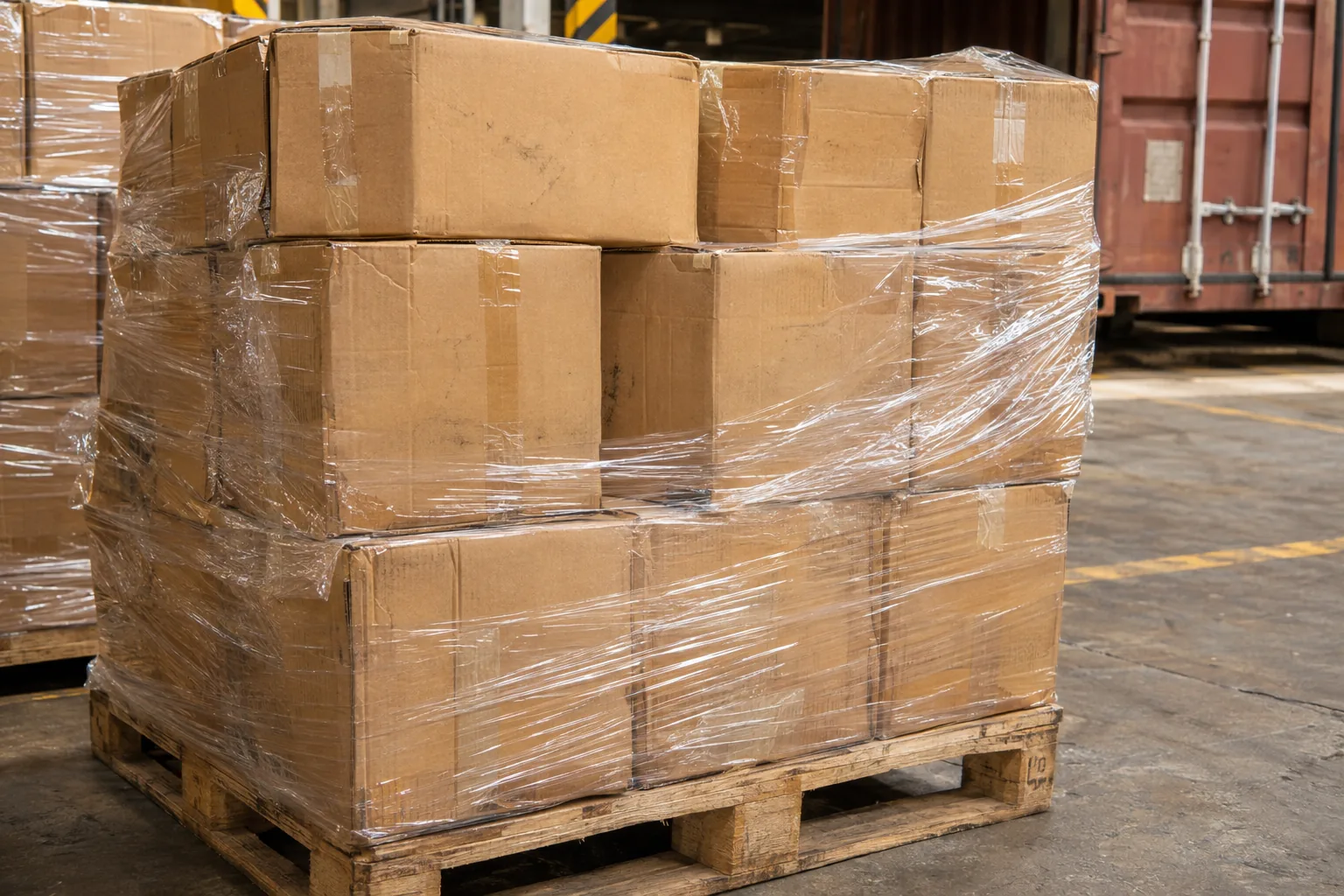
ISPM-15 exemption
ISPM-15 is the international rule that requires solid wood packaging to be heat-treated or fumigated before export. It applies to wooden pallets, crates and dunnage. The process adds cost, documentation and delay — and if the certificate is wrong, the shipment can be refused at the destination port.
Corrugated pallets contain no solid wood. They are exempt from ISPM-15, which means no heat treatment, no methyl bromide fumigation, and no phytosanitary certificate. For air freight and LCL shipments, this alone is often enough reason to switch.
Weight and freight savings
A 1,200 × 1,000 mm corrugated pallet weighs 3.5–6 kg. A wooden pallet of the same footprint weighs 18–25 kg. On air freight, that weight difference is billed directly. On ocean freight it matters less per pallet, but it still adds up over a full container.
Disposal at destination is also cheaper. A corrugated pallet can be flattened and recycled in standard cardboard streams. A wooden pallet usually requires paid collection or return to a pool.
| Criteria | Corrugated | Wood | Plastic |
|---|---|---|---|
| ISPM-15 treatment | Not required | Required | Not required |
| Unit weight (1.2 × 1.0 m) | 3.5–6 kg | 18–25 kg | 14–20 kg |
| Static load | 500–1,500 kg | 1,500–4,000 kg | 1,000–2,500 kg |
| Reuse cycles | 1–3 | 10–20 | 50–100 |
| Disposal | Recyclable paper | Paid / return | Limited streams |
Load capacity
Corrugated pallets are not weaker versions of wooden pallets — they are engineered for a different job. A standard 1,200 × 1,000 mm triple-wall pallet with honeycomb deck carries 500–1,500 kg static load when floor-stacked and 250–750 kg dynamic load when moved by forklift. Load capacity depends on deck span, stringer design and humidity.
For concentrated loads, we add a honeycomb deck insert or additional fold-form stringers. For humid corridors, we specify a water-resistant coating that restores compression lost to moisture.
Limits and when not to use
Corrugated pallets are one-way or limited-reuse products. Do not use them when:
- The pallet must survive more than three handling cycles.
- The pallet will sit outdoors or in an unconditioned humid warehouse for weeks.
- The load exceeds the pallet's rated static or dynamic capacity.
- The destination requires a closed-loop pallet pool such as CHEP or LPR.
For these scenarios, wood or plastic remains the better choice.
Decision summary
Choose corrugated for one-way export, air freight, food and pharma, and any lane where ISPM-15 documentation is a bottleneck. Choose wood for closed-loop systems and heavy loads above 1,500 kg. Choose plastic for washdown environments and long-term reuse.
Want a load calculation?
Send product weight, dimensions, destination and handling mode. We'll specify a corrugated pallet or tell you honestly if wood or plastic is the better fit. Request a pallet review.