Key takeaways
- PPWR applies to all packaging materials, including corrugated. The recycled content targets you hear about apply to plastic only.
- The empty space ratio is capped at 50% for transport and e-commerce packaging, with 1 January 2030 as the working deadline.
- Void fill counts as filling inside the box and does not exempt a carton from the ratio.
- Recyclability performance grades apply from 1 January 2030, with a stricter A/B requirement from 2038.
- EUDR covers wood as a commodity; carton scope depends on the CN code and on your role in the chain.
- For most buyers the change is documentation, not tooling — unless the carton is oversized or carries a non-paper element.
Two regulations, two questions

Buyers in the EU are currently receiving two very different letters from suppliers, and they are easy to confuse. One says the packaging has to be recyclable and minimal. The other says the wood fibre needs a due diligence statement. They sound like the same message. They are not.
PPWR is the Packaging and Packaging Waste Regulation, Regulation (EU) 2025/40. It replaced the 1994 Packaging Directive, and unlike a directive it applies directly in every member state without national transposition. It governs the pack itself: how heavy it is, how much air it contains, whether it can be recycled, what is printed on it, which substances it may contain, and what documentation must exist to prove all of that.
EUDR is the EU Deforestation Regulation. It governs a commodity and its supply chain. Wood is one of the seven commodities in scope. It asks whether the material came from land that was deforested after 31 December 2020, whether it was legally produced, and whether you can show both of those things with geolocation data.
A corrugated carton is caught by both, for different reasons, and the answers come from different parts of your supplier relationship. PPWR asks the converter about board construction and tooling. EUDR asks the mill about where the fibre grew.
The six dates
Compliance conversations go wrong when dates get blurred. These are the ones that matter, in order.
| Date | What happens | Who it lands on |
|---|---|---|
| 12 Aug 2026 | PPWR applies in full: heavy metal limits, conformity assessment, declaration of conformity, technical documentation | Brand owner placing packaging on the EU market |
| 30 Dec 2026 | EUDR applies to medium and large operators and traders | Operator first placing the product on the EU market |
| 12 Feb 2027 | EPR obligation labelling on packaging | Producer registered in each member state |
| 30 Jun 2027 | EUDR applies to micro and small enterprises | Smaller operators |
| 12 Aug 2028 | Harmonised material composition label | All packaging placed on the market |
| 1 Jan 2030 | Minimisation duty, 50% empty space ratio, recyclability grades A/B/C | Design and documentation owners |
| 1 Jan 2038 | Recyclability restricted to grades A and B | Design owners |
Dates as set out in Regulation (EU) 2025/40 and in the Commission's EUDR application timeline. Some PPWR dates are expressed as "or later" because they depend on implementing acts. Confirm the binding date in the current Commission guidance before you build a compliance plan around it.
Two things stand out from that table. First, the heaviest design work — minimisation and recyclability grading — lands in 2030, not 2026. Second, the 2026 deadline is mostly about documentation. That is the opposite of what most buyers assume, and it changes what you should be doing this quarter.
Article 10 and the empty space ratio

Article 10 requires packaging to be designed so that its weight and volume are reduced to the minimum necessary for it to function. The interesting part is not the sentence, it is the test. A design that adds weight or volume has to trace back to one of the performance criteria in Annex IV: product protection, the manufacturing and filling process, logistics, hygiene and safety, shelf life, avoidance of substances of concern, or legal information requirements. Marketing and perceived value are not, on their own, valid grounds for extra material.
Article 24 turns that principle into a number. For grouped packaging, transport packaging and e-commerce packaging, the empty space ratio is capped at 50%. In plain terms, the void between the product, its sales packaging and the inside walls of the outer box must not exceed half the box volume.
| Scenario | Product volume | Empty space | Ratio | Position vs 50% cap |
|---|---|---|---|---|
| Two cartons of 12 × 9 × 6 in in a snug shipper | 1,296 in³ | 1,504 in³ | 54% | Over the cap |
| Two cartons plus a corrugated divider | 1,296 in³ + 170 in³ divider | 1,334 in³ | 48% | Inside the cap |
| Same two cartons in a 24 × 16 × 12 in shipper | 1,296 in³ | 3,313 in³ | 72% | Well over the cap |
| Same two cartons, 24 × 16 × 12, with paper fill | 1,296 in³ | 3,313 in³ | 72% | Still over — fill does not count |
The third and fourth rows are the important ones. Paper void fill occupies the empty volume, but it does not remove it from the calculation, because the ratio measures the void inside the outer packaging whether or not something is sitting in it. The escape route is not more filler. It is either a smaller box, or a structural insert that is designed in — a corrugated divider that is part of the packaging and is justified under the logistics or protection criteria.
This is where the PPWR conversation connects to the carton sizing work most buyers have already been doing for cost reasons. A carton that was 25% oversized was previously a dimensional weight problem. From 2030 it is also a conformity problem, and the second one cannot be solved by negotiating a carrier contract.
Recyclability grades
PPWR introduces design-for-recycling performance grades, commonly described as A, B and C, tied to the proportion of the packaging by weight that is effectively recycled in practice. The grades apply from 1 January 2030, and from 1 January 2038 only grades A and B are permitted.
Corrugated is structurally well placed here. Paper and cardboard already account for the largest single share of EU packaging waste by weight, and the collection and recycling infrastructure for it is mature across the member states where your customers are. A plain brown RSC, printed with water-based flexo ink and closed with paper tape, is about as straightforward a packaging unit as the regulation will see.
The complication is that the grade is assessed on the whole packaging unit, not on the board. Constructions that pull a carton down are the ones you cannot separate at the recycling plant:
- Plastic film windows on printed retail cartons, unless designed to be removed.
- Metallised or foil-stamped board, where the metal layer cannot be separated in the repulping process.
- Heavy polyethylene coating used for moisture or grease resistance, as opposed to a light dispersion coating.
- Adhesives and laminating films that do not disperse in the pulper.
- Moulded pulp or foam inserts bonded into the carton so that the consumer cannot separate them.
None of those are automatically prohibited. They have to be justified against a minimisation criterion and checked against the grade. But they are the design decisions that turn a straightforward conformity file into an argument, and they are worth reviewing before the tooling is cut rather than after.
EUDR and wood fibre
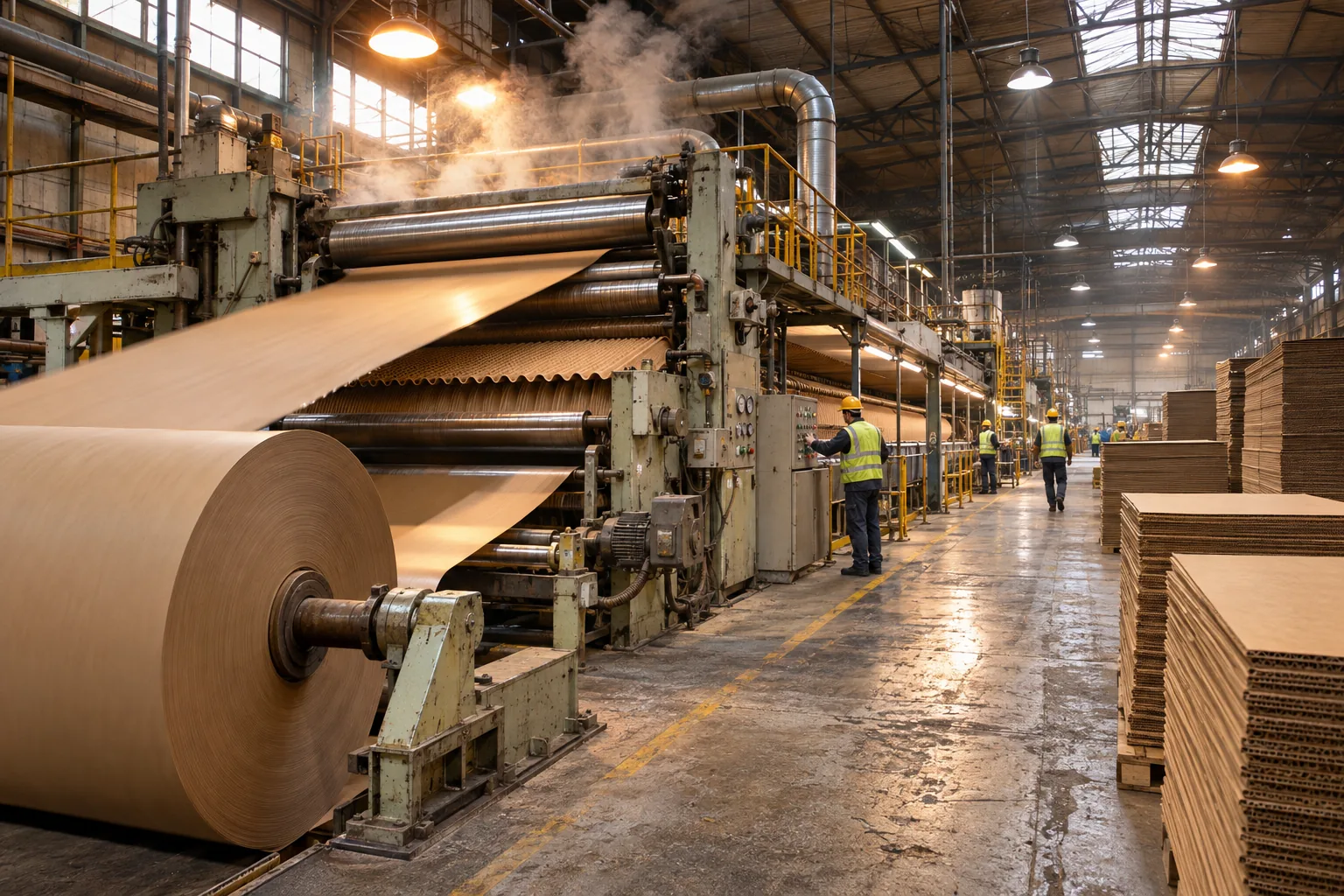
EUDR entered into force in June 2023 and applies to medium and large operators from 30 December 2026, with micro and small enterprises following on 30 June 2027. It covers seven commodities: cattle, cocoa, coffee, oil palm, rubber, soya and wood, plus certain derived products listed in Annex I.
Wood is the relevant one here. The obligation falls on the operator that first places the relevant product on the EU market, or exports it from the EU. That operator must carry out due diligence showing three things: the product is deforestation-free, meaning it does not originate from land deforested after 31 December 2020; it was produced legally under the laws of the country of production; and it is covered by a due diligence statement containing, among other things, the geolocation of the plots where the wood was harvested.
Whether a particular corrugated carton falls inside the product scope depends on its CN code and on how it enters the market. That is a question for your customs classification and your compliance adviser, not for your carton supplier's opinion. What the supplier can do is give you the inputs: which mills the linerboard came from, what the chain of custody documentation says, and whether the fibre is virgin or recycled.
Where recycled fibre changes the picture
A high recycled content liner does not automatically remove a product from EUDR scope, and it does not automatically satisfy it either. It changes the traceability question, because recovered fibre has a different origin story from virgin pulp. What matters is being able to describe that story consistently, in writing, for the specific product you are placing on the market. Ask your supplier which mills supply the linerboard and what documentation exists, before you are asked the question by a market surveillance authority.
What does not change
Most of the specification work buyers are worried about does not actually have to move. It is worth being explicit about that, because the compliance conversation tends to produce unnecessary re-engineering.
Board grades stay the same. PPWR does not ban ECT 32, 44 or 61, does not require a minimum recycled content for paper, and does not mandate a particular flute profile. If your carton performs today, the board that makes it is still compliant.
Print methods stay the same. Water-based flexo and litho lamination on paper liners are both established in the European paper recycling stream. The regulation targets constructions that cannot be separated, not the act of printing.
Strength requirements stay the same. The minimisation duty is about unnecessary weight and volume, not about removing the material that carries the load. A triple-wall carton for a 900 kg industrial part is not "over-packaged" in the PPWR sense, because the protection criterion justifies every millimetre of it.
Lead times and MOQs are a commercial matter. Nothing in either regulation changes the physics of a production run. What does change is the amount of paper that moves alongside the cartons.
The compliant carton spec sheet

If you are rebuilding a specification document for a European buyer, these are the fields that a conformity file needs. Most of them you already collect; the rest come from the mill.
- Board construction: liner grades, flute profile, wall count, ECT or BCT value
- Outer dimensions and internal dimensions, separately, with board caliper stated
- Product envelope and packed volume, so the empty space ratio can be calculated
- Void fill or insert: material, volume occupied, and whether it is separable
- Fibre origin: mill, country of pulp, chain of custody certification and its scope
- Recycled content by weight, and whether it is post-consumer or pre-consumer
- Heavy metal declaration: cadmium, lead, mercury and hexavalent chromium, summed
- Food contact status, and PFAS declaration where the carton touches food
- Print method, ink chemistry and any coating or laminate, with grammage
- Separability note: which components a consumer can remove before recycling
- Recyclability position in the destination market, with the test or standard referenced
- Applicable declarations, with version numbers and dates
The item buyers most often leave out is the pair of dimension rows. Without both the outer and the inner dimensions and the caliper between them, nobody can calculate the empty space ratio, and the file is incomplete on the first question an authority would ask.
What to do this quarter
Four actions, in the order that reduces the most risk per hour spent.
- Separate the two regulations in your own documentation. Give PPWR and EUDR their own sections and their own owners. Teams that merge them end up asking a converter for geolocation data and a mill for a declaration of conformity, and neither can supply it.
- Calculate the empty space ratio on your top ten cartons. Outer volume minus product and justified packaging volume, over outer volume. Any carton above 40% is a candidate for a size review before 2030, and the review will usually also reduce dimensional weight.
- List every non-paper element in the construction. Windows, films, coatings, metallised areas and bonded inserts. For each one, write down the criterion that justifies it or the alternative that removes it. This list is the recyclability grade conversation.
- Ask for fibre documentation now, not in 2027. Which mills, which countries, which certification scope, and whether recycled fibre is involved. If a supplier cannot answer this for a 2026 order, it is unlikely to answer it well under a 2026 deadline.
The companies that will find this manageable are the ones that treat PPWR as a specification and sizing exercise, and EUDR as a supply chain documentation exercise. The ones that will struggle are the ones that wait until a customer asks for a declaration and then try to reconstruct three years of board provenance from purchase orders.
Send us the carton, not the regulation
We will tell you what the construction currently is, what the empty space ratio works out at, which components sit outside the paper stream, and what happens to the per-unit price if you change any of it. No obligation, and no need to have the artwork finalised. Start a specification review or message us on WhatsApp.