The client
A US direct-to-consumer apparel brand selling casual basics online. Average order contained two to three folded garments. The brand shipped roughly 12,500 parcels per month and was growing fast. Packaging was viewed as a commodity — they bought whatever box their 3PL recommended.
The problem
Two costs were creeping up: carrier spend and returns for damaged goods.
- The existing mailer was a generic 32 ECT C-flute tuck-end box, 11.5 × 9 × 3.5 in internal. It was too large for a typical two-garment order, so the 3PL filled the empty space with tissue paper and an air pillow.
- Dimensional weight was 1.2 lb, billing at the 2 lb band. Actual product weight was only 0.6 lb.
- The box had no internal locking feature, so garments shifted in transit and roughly 0.9% of deliveries arrived with crushed corners or opened seams, generating replacements and negative reviews.
Diagnosis
We asked for three pieces of data: the product's folded footprint, the actual stack height of a two-garment shipment, and the carrier's dim-weight divisor. The folded footprint was 9.5 × 7 in. With a 0.75 in thick insert card, the ideal internal height was 2.25–2.5 in.
The existing box gave 27% unused volume on the average order. That unused volume translated directly into higher dim weight, more fill material, and a box that looked half-empty when opened.
The solution
We redesigned the mailer around the product rather than around the nearest standard size.
| Parameter | Before | After |
|---|---|---|
| Internal dimensions | 11.5 × 9 × 3.5 in | 10.5 × 8 × 2.75 in |
| Construction | Tuck-end RSC-style mailer | Self-locking auto-bottom mailer |
| Board | 32 ECT C-flute | 32 ECT E-flute |
| Caliper | 4.0 mm | 1.6 mm |
| None | One-colour flexo logo | |
| Closure | Clear tape | Peel-and-seal strip |
| Internal support | Tissue + air pillow | Die-cut corrugated platform |
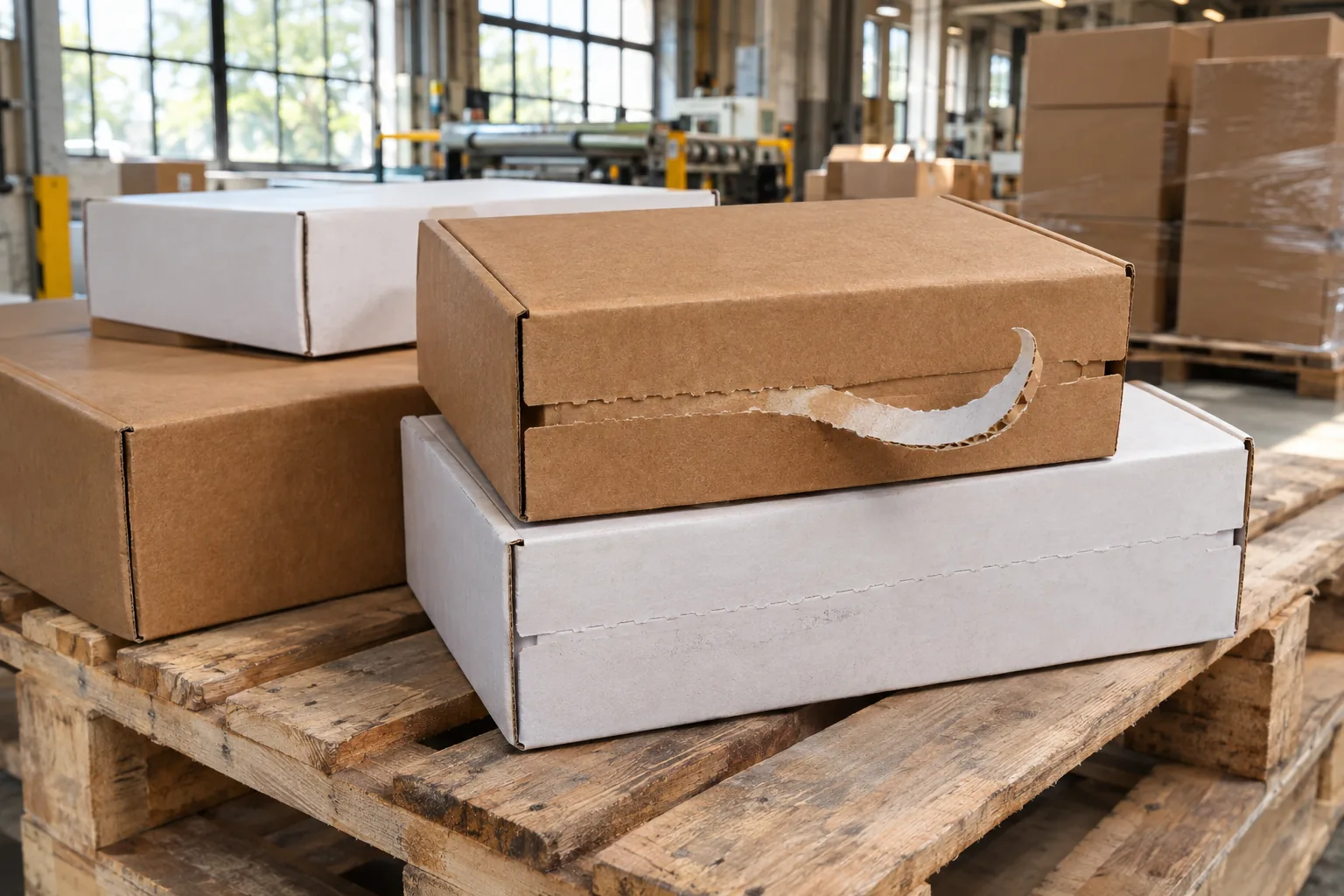
The self-locking auto-bottom structure removed tape from the pack station and gave a cleaner opening experience. We added a peel-and-seal strip so the customer could reuse the same box for returns, which the brand promoted as a sustainability feature.
Measured results
The change paid for itself in under three months. Because the box was smaller and flatter, pallet efficiency also improved: roughly 12% more flat mailers per pallet, reducing outbound freight from our factory by one partial pallet per 40HQ container.
Lessons
- Start with the folded product footprint. If the box is sized for the average order rather than the largest possible order, most shipments cost less.
- E-flute is not weaker for small parcels. At 1.6 mm caliper, 32 ECT E-flute handles 2–3 kg comfortably and prints cleaner than C-flute — ideal for DTC unboxing.
- A die-cut platform beats void fill. It costs $0.04–$0.08 per unit, prevents shifting, and is recyclable in the same stream as the box.
- Reusable return packaging is a retention tool. The peel-and-seal return strip cost $0.03 per unit and became a marketing talking point.
Could this apply to you?
If your parcel carrier bills by dimensional weight and your box has more than 15% unused volume on the average order, a resize usually pays back within one quarter. Send your product dimensions and current box size and we'll model the saving.