The client
A growing cosmetics brand launching a new skincare line in a national US big-box retailer. The launch window was fixed — displays had to be in distribution centres by a specific date, with no allowance for resubmission or rework.
The problem
The retailer required a half-pallet display loaded with 72 units, floor-standing, with a tear-away front panel for shelf-ready presentation. The display had to:
- Survive a 1,200-mile truck journey from the retailer's distribution centre to stores without crushing or tipping.
- Be set up by store staff without tools, instructions or training.
- Pass the retailer's receiving inspection, which included a 12-inch corner drop and a 30-day compression hold at full load.
- Carry high-quality print — the header was part of the in-store marketing.
The design
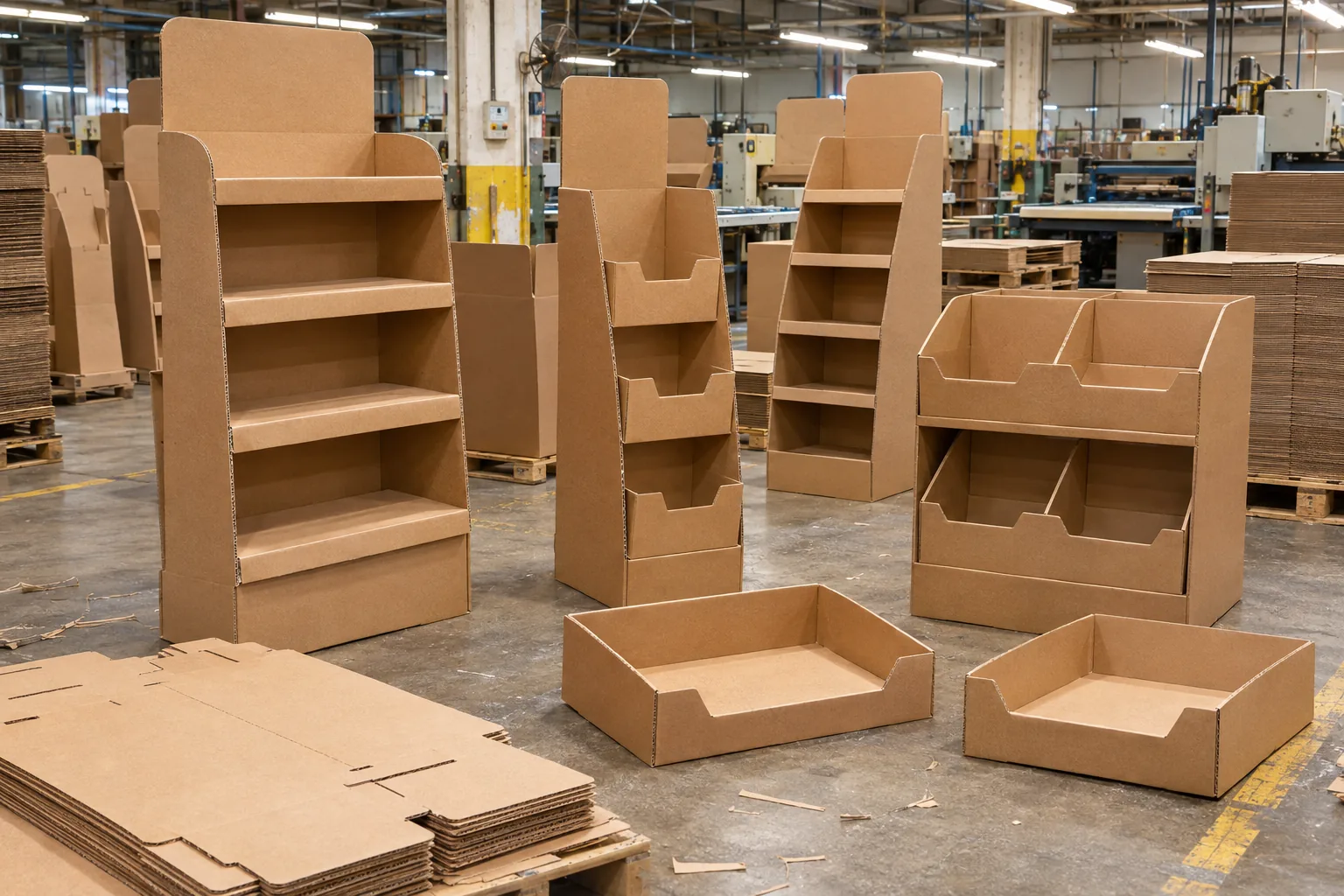
We engineered a half-pallet footprint display at 1,200 × 800 × 1,450 mm loaded height. The structure used BC double-wall board (48 ECT) for the body and E-flute litho-laminated panels for the header, side wraps and tear-away front.
Key features:
- Pallet base — integrated corrugated pallet feet with forklift entry on two sides, eliminating the need for a separate wooden pallet.
- Pre-loaded tiers — four tiers of 18 units each, separated by die-cut corrugated shelves with front lips to stop product falling forward.
- Tear-away front — perforated panel removed cleanly to expose product and create a branded header.
- Tool-free assembly — display unfolded from flat to standing in three locking motions, held by integral tabs.
Production and testing
The timeline was 14 weeks from concept to in-store. We produced three prototypes: a white sample for structural review, a printed pre-production sample for colour approval, and a fully loaded sample for the retailer's drop and compression test.
Testing sequence: ISTA-3A single-parcel simulation for the individual unit, plus a 30-day loaded compression hold and corner drop for the display as shipped. The display passed on the first submission, which protected the launch date.
Results
The launch was on time and under the packaging budget. The retailer later invited the brand to expand the programme to a second seasonal line using the same display footprint with a new litho skin.
Planning a retail display?
The two failure points are structural approval and in-store setup. Start with the retailer's published spec, build a loaded prototype, and never commit artwork before the structure passes drop testing. Send the spec and we'll design to it.